


- Is AFC Scholarship Fund Legit? What Donors Should Know About Its Backing and Compliance - September 25, 2026
- What Is the Federal Tax Credit for K-12 Scholarships? - September 25, 2026
- Clearity Health Review: What It Does, What It Costs, and Who It’s For - September 6, 2026
Anyone about to give money to an organization they’ve never heard of before should ask this question, and with a brand-new federal tax credit on the table, it’s a smart one to ask before, not after, you donate. Here is a straightforward look at who is actually behind AFC Scholarship Fund, how to verify it independently using the same tools you’d use for any nonprofit, one specific mix-up worth clearing up if you’ve been researching this online, and what the compliance structure underneath it actually requires.
The Short Answer
Yes, AFC Scholarship Fund is a legitimate, registered nonprofit. It is a Dallas-based organization built to operate as a national Scholarship Granting Organization (SGO) under the incoming Education Freedom Tax Credit (EFTC), and is verifiable through independent, third-party sources rather than just its own websites. The rest of this piece walks through exactly how to check that for yourself, so you’re not just taking anyone’s word for it, including ours.
Who Is Actually Behind It
AFC Scholarship Fund is not a standalone startup operating without institutional backing. The American Federation for Children announced its launch as a national scholarship granting organization, backed by more than ten million dollars secured for the national awareness campaign needed to bring the Education Freedom Tax Credit to families. The American Federation for Children (AFC) is a long-running school choice advocacy organization, and this fund is its affiliated nonprofit built specifically to operate as an SGO once the federal credit takes effect.
It’s worth understanding the relationship between the two organizations because it’s a common source of confusion. American Federation for Children operates as a 501(c)(4) social welfare and advocacy organization, the kind of structure typically used for policy advocacy and legislative engagement rather than direct tax-deductible giving. AFC Scholarship Fund, by contrast, is organized as a separate 501(c)(3) charitable entity, which is the structure required to operate as a qualified SGO and to allow donor contributions to generate the federal tax credit. This is a normal and common setup; plenty of advocacy organizations maintain affiliated charities for exactly this reason, but it’s a useful distinction to understand. The advocacy organization built the case for the policy, and AFC Scholarship Fund is the separate charitable organization actually built to execute the scholarship program the policy created.
On the operational side, it runs on scholarship infrastructure from Odyssey, an organization with a track record of moving more than three billion dollars in scholarships and serving over 157,000 students across a dozen states. That matters for a legitimacy check because it means the organization isn’t building scholarship administration, eligibility verification, and compliance tracking from a blank slate. It’s layering a new federal program on top of infrastructure that already has years of operating history processing scholarship applications, verifying family income, and disbursing funds to schools and service providers.
Checking It Independently
Don’t just take a nonprofit’s word for its own legitimacy; check it against sources. This is good practice for any nonprofit you’re considering giving to, not just this one, and there are a handful of standard tools that work for essentially any 501(c)(3) in the country.
The IRS Tax Exempt Organization Search. This free tool lets you confirm whether an organization currently holds valid 501(c)(3) status, using its name or EIN. It’s the most authoritative source available, since it comes directly from the agency that grants and can revoke tax-exempt status.
Charity Navigator. AFC Scholarship Fund has a public profile on Charity Navigator, one of the most widely used independent nonprofit evaluators in the country, listed under its Dallas, Texas headquarters. Because the organization is newly formed, it hasn’t yet accumulated the multi-year Form 990 filing history that Charity Navigator requires before issuing a star rating, which is normal and expected for any nonprofit in its first year or two of operation.
Candid, formerly GuideStar. This is another widely used nonprofit database that aggregates filings, mission statements, and basic financial data, and it’s a reasonable second source to cross-reference against Charity Navigator.
State charity registration. Many states require nonprofits soliciting donations from their residents to register with a state charity regulator, often the state attorney general’s office. Checking whether an organization is registered in the states where it’s actively soliciting is another independent data point.
A “not yet rated” status on a new organization is simply a timing issue tied to how long the organization has existed. What would actually be concerning is an organization that’s been operating for many years with no filing history at all, or one that doesn’t show up in the IRS’s exempt organization database as currently active. Neither of those describes AFC Scholarship Fund.
How Compliance Actually Works
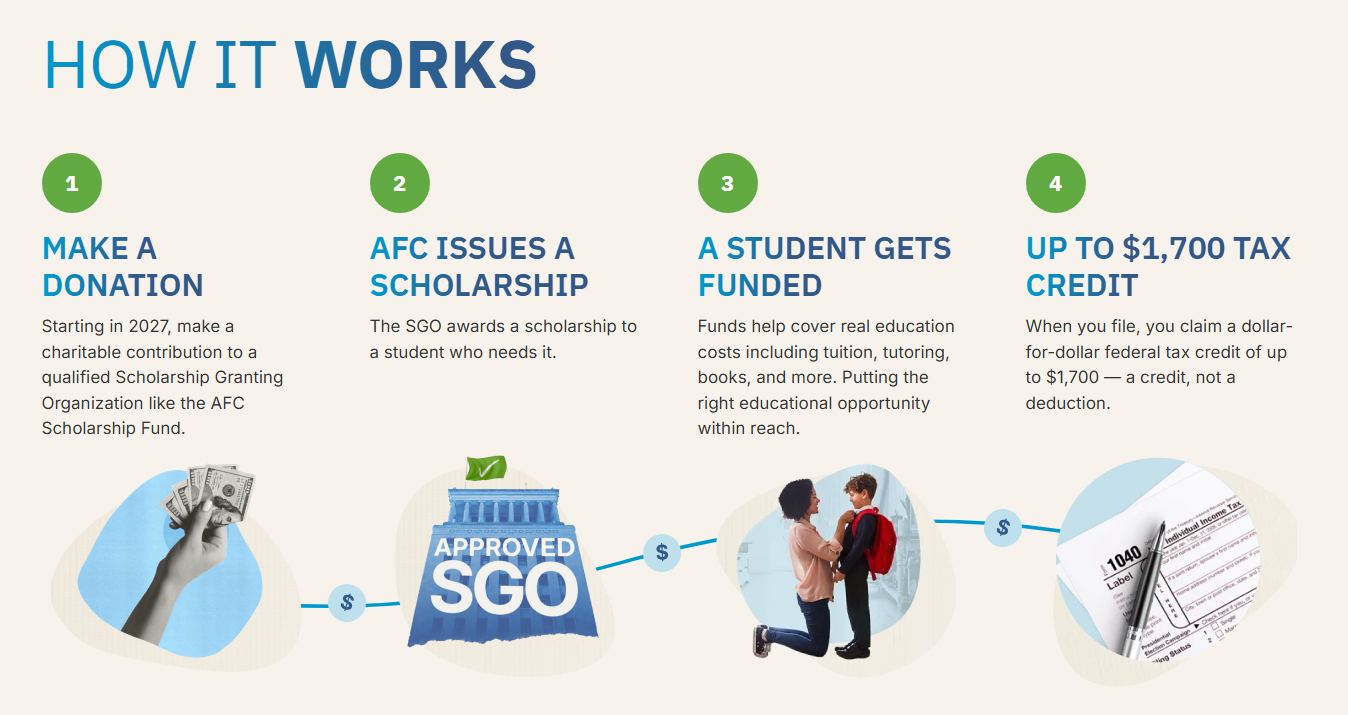
Legitimacy for an SGO isn’t just about who founded it. It’s also about the structure that governs how donor money moves once it arrives. AFC Scholarship Fund operates under the same federal framework every qualified SGO must follow:
The 90/10 rule. At least 90 percent of qualifying revenue has to go toward student scholarships, capping administrative costs at 10 percent. This is a federal requirement, not an internal policy choice, and it’s the mechanism that keeps a donor’s contribution from disappearing into overhead.
Fund segregation. Contributions are required to be held separately and not commingled with other organizational funds, which supports clean audit trails. For an organization operating in multiple states, this typically extends to maintaining separate sub-accounts for each state, so funds raised for one state’s students can be verified as actually reaching that state.
No earmarking. Donors can’t direct funds to a specific student, which closes off a common source of conflict-of-interest concerns in scholarship programs.
Disqualified-person restrictions. Board members and major donors are excluded from receiving scholarships funded by the organization they’re connected to, which prevents an obvious form of self-dealing.
Eligibility verification. Scholarships are awarded to students who meet federal eligibility standards, which cover approximately 90 percent of American K-12 students, with verification handled by the SGO rather than left to self-reporting.
Annual re-certification. Qualification isn’t a one-time event. States are expected to re-certify their lists of qualifying SGOs annually, which means an organization has to maintain compliance on an ongoing basis, not just clear a bar once and coast.
No double benefit. A dollar claimed as this federal credit can’t also be separately deducted as a charitable contribution. It’s one benefit per dollar given, not both stacked together.
When the donor portal launches, giving through AFC Scholarship Fund is designed to route a contribution through this compliance structure automatically, so a donor isn’t expected to independently verify each of these steps on a gift-by-gift basis.
What This Means for Your Tax Credit
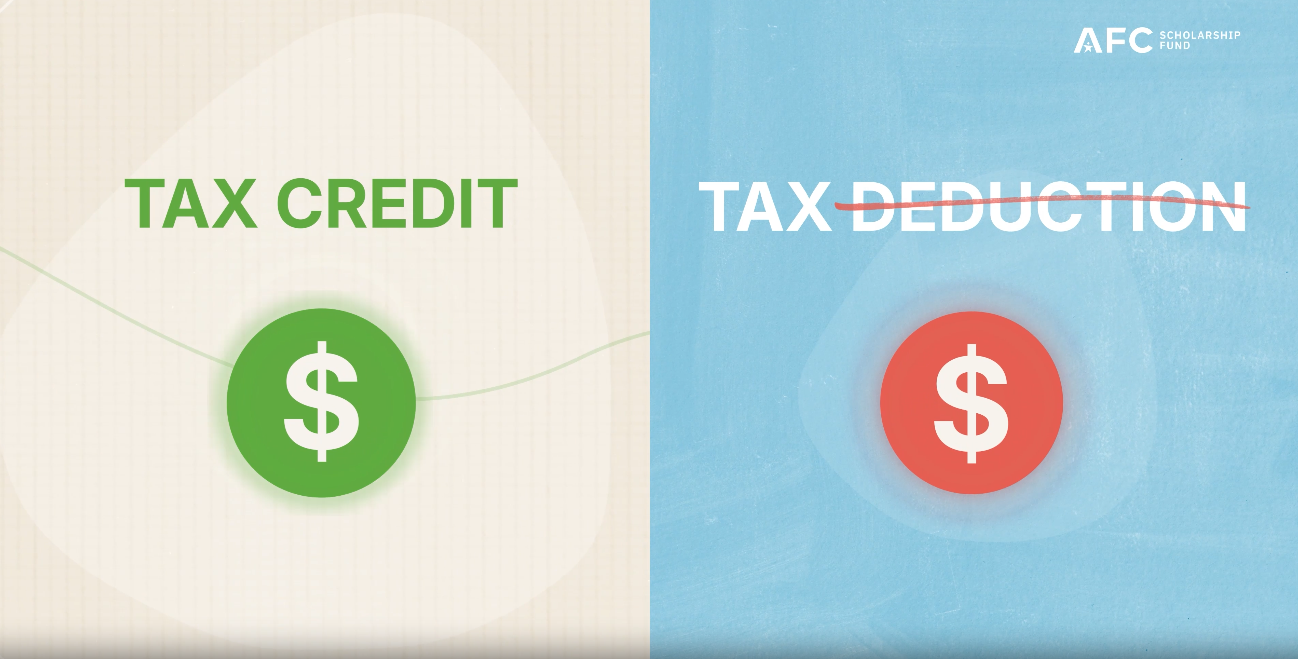
Starting January 1, 2027, a qualifying contribution to AFC Scholarship Fund is designed to generate a dollar-for-dollar federal tax credit of up to $1,700 (Treasury rules pending) once you file. More than 30 states have already opted into the program, and that number is still growing. Because the credit depends on giving to a properly qualified SGO in a state that has opted in, the legitimacy question isn’t just a matter of trust. It’s also a practical prerequisite for the credit to apply at all. Donating to an organization that isn’t a recognized SGO, including one that happens to share a similar name with a real one, wouldn’t generate this credit, regardless of how well-intentioned the gift was.
Common Questions Donors Ask

Is AFC Scholarship Fund the same organization as the American Federation for Children? No. They’re affiliated but separate legal entities. American Federation for Children is a 501(c)(4) advocacy organization; AFC Scholarship Fund is the 501(c)(3) charitable arm built to operate as an SGO.
Why doesn’t AFC Scholarship Fund have a Charity Navigator star rating yet? Star ratings require several years of Form 990 filing history, and the organization is newly formed. This is standard for any new nonprofit and isn’t itself a compliance concern.
Is the Maryland organization with a similar name connected to AFC Scholarship Fund in any way? No. AFC Scholarship Foundation Inc. in Odenton, Maryland is a separate, unrelated nonprofit with its own EIN, its own leadership, and no organizational tie to the American Federation for Children or to AFC Scholarship Fund.
How can I verify any of this myself instead of trusting an article about it? Use the IRS Tax Exempt Organization Search to confirm active 501(c)(3) status, cross-reference the EIN against Charity Navigator or Candid, and check state charity registration where applicable. These are the same tools that work for verifying any nonprofit, not just this one.
Bottom Line
AFC Scholarship Fund is backed by an established school choice advocacy organization, operates on scholarship infrastructure with years of prior track record, and is independently listed with a major nonprofit evaluator under its own distinct EIN. The organization that shows up in some searches with a nearly identical name is a separate, unrelated nonprofit with no bearing on this one. For a donor doing due diligence before the Education Freedom Tax Credit takes effect, that distinction, along with the compliance structure, the 90/10 rule, and its related requirements, is exactly what’s worth confirming before giving. It’s the kind of confirmation you can do yourself in a few minutes using publicly available tools rather than taking anyone’s word for it.