

- What Is the Education Freedom Tax Credit for K-12 Scholarships? - September 25, 2026
Are you looking to lower your tax bill while also making a difference in students’ lives? You may have heard about a new opportunity to do both, which will be available starting next year: the Education Freedom Tax Credit (also known as the Federal Scholarship Tax Credit).
The Education Freedom Tax Credit (EFTC) is the first tax credit of its kind that goes directly to students and families who are trying to pay for K-12 education. It has a unique structure that makes it different from other tax opportunities, and we’ll go through that below.
What Does The EFTC Do For You?

Great question! The EFTC allows everyday people to claim a credit on their taxes each year of up to $1,700 per person, or up to $3,400 for married couples filing jointly (interim regulation for next year and can still change; pending finalization for following years). To get it, you have to contribute to an eligible Scholarship Granting Organization (SGO).
What’s unique about it is that it lets you, the taxpayer, lower your bill dollar for dollar, based on how much you contributed. Once the EFTC goes into effect, a $3,400 tax credit would reduce the amount you owe by $3,400. It’s that simple!
By contrast, a standard tax deduction only changes how much of your income is being taxed. That’s still valuable, but would save you just a fraction of what the EFTC would. The EFTC is also different from other policies, like the Child Tax Credit (CTC), in that you have to take a specific action and make an eligible donation to get it. It’s worth remembering that you can claim the EFTC and also claim other tax credits, as long as it’s not on the same donation.
What Is An SGO?

A Scholarship Granting Organization (SGO) is a 501(c)(3) non-profit or charity that uses donations to fund students who are pursuing private K-12 education. In order to become an SGO and be eligible to participate in this program, an organization has to allocate at least 90% of its revenue directly to scholarships. That way, you’ll know that your donation to an SGO will help students and families directly.
How Do Scholarships Help Students?
Scholarships are awarded by SGOs to students and families, and they can be used for a variety of purposes. It’s most common for scholarships to go towards tuition, fees, private tutoring, or other expenses that without the scholarship, they either couldn’t afford or would pay out of pocket.
While the majority of scholarship dollars from SGOs support students who attend private schools, this is not always the case. Under the Educational Choice for Children Act (ECCA), which created the EFTC and was passed in 2025, SGOs can fund “qualified elementary or secondary education expenses” for students in public schools, charter schools, or even homeschooling. Those can include activity fees, books, educational therapies, and instructional software: essentially, anything that isn’t provided by a traditional public school.
Who Can Get A Scholarship?
Students in kindergarten through 12th grade (K-12) are eligible to receive scholarships from an SGO if they meet specific criteria. Those can vary from state to state, but there are a few that are standard across the board. Among other things, students have to:
- Be eligible to enroll in a K-12 public school
- Reside in a state where their scholarship provider operates
- Have a family income at or below 300% of their area’s median income
The family must then apply for the scholarship from an SGO through that organization’s process. Each organization will have their own process, criteria, and method for awarding funds once families apply. There are some regulations on SGOs and how they allocate funds; for example, organizations need to verify family incomes for recipients and can’t give scholarships to people who are on their board or their immediate family. As long as they stay in legal compliance, though, SGOs can award the donations they receive as they see fit.
If you’re considering donating to an SGO and claiming the EFTC, it’s worth looking into that organization, who they serve, and how they award their scholarships.
Who Do I Give To?

Any time you donate to a nonprofit or charity, you want to make sure your dollars make a difference. To decide which organization to donate to, you should research organizations eligible for the program and consider ones that are aligned with your values.
To learn more about an organization, you can check out its social media presence, its website, and its annual reports, which will typically be published online. If you can look for success stories or metrics about the organization’s impact, that can provide reassurance that you’re making a worthy investment.
SGOs frequently include private school foundations, public school-affiliated organizations, archdioceses, religious organizations, and various other charities. Some are national organizations, and some serve local student populations. If you live in a state that participates in the program, your donation can help local families directly.
Many new SGOs have been created specifically to direct funds tied to the tax credit to students and families. One of these, AFC Scholarship Fund, is a national organization that distributes K-12 scholarships to eligible students across the country. To date, the organization has allocated over $3 billion in scholarship funds to over 150,000 students.
Am I Eligible To Participate?
Not yet. The EFTC begins January 1st, 2027, so it’s a brand new pilot opportunity.
While individuals in any state can donate to an eligible organization, not all states have eligible organizations to give to. Individual states need to opt in to the program in order for organizations in their state to receive donations that people can claim for the credit. So far, about 30 states have opted in. You can see the list here.
Each participating state also needs to provide the Internal Revenue Service with a list of SGOs that are eligible to receive these donations. Before donating, make sure your chosen organization is eligible in at least one state, whether that’s the one you live in or not.
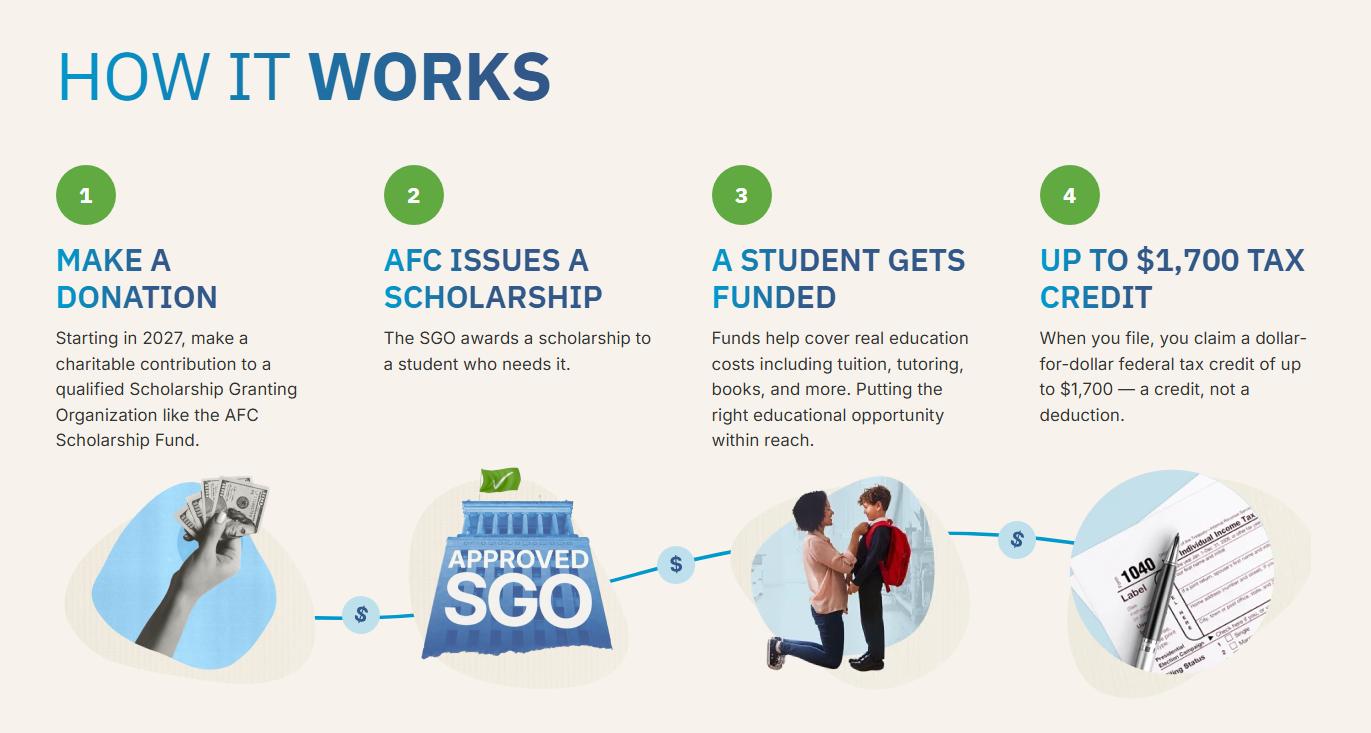
After January 1st, participating SGOs will be able to accept donations that are applicable for the EFTC. Once that happens, you’d take the following steps to get the EFTC:
- Verify that your chosen SGO is located in a state that participates in the program.
- Make a cash donation to that SGO.
- File your taxes, claiming the dollar-for-dollar non-refundable credit on your federal tax return. Keep in mind that you cannot claim both the EFTC and a federal charitable deduction for the same donation.
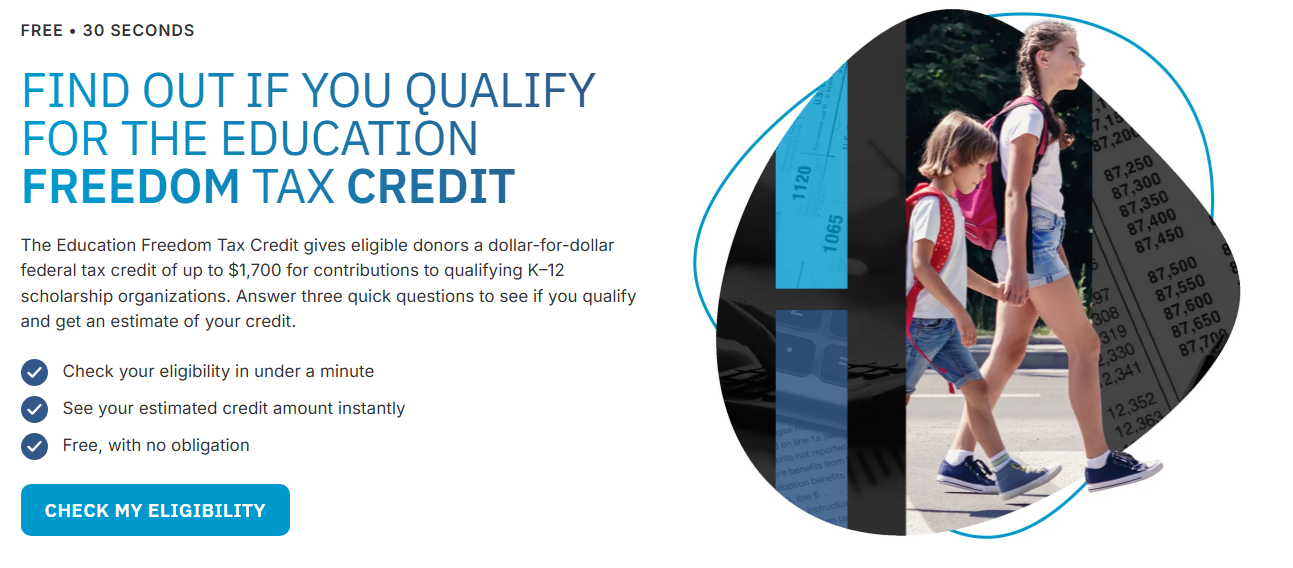
To help you estimate your eligibility and potential tax liability after the credit, you can use this calculator from the AFC Scholarship Fund. For additional guidance, consult a tax professional for advice about your specific situation.