


- The Best Sites Like NerdWallet for Comparing Financial Products - September 18, 2026
- The Best Business Loan Comparison Sites - August 29, 2026
- How to Compare High-Yield Savings Accounts - August 18, 2026
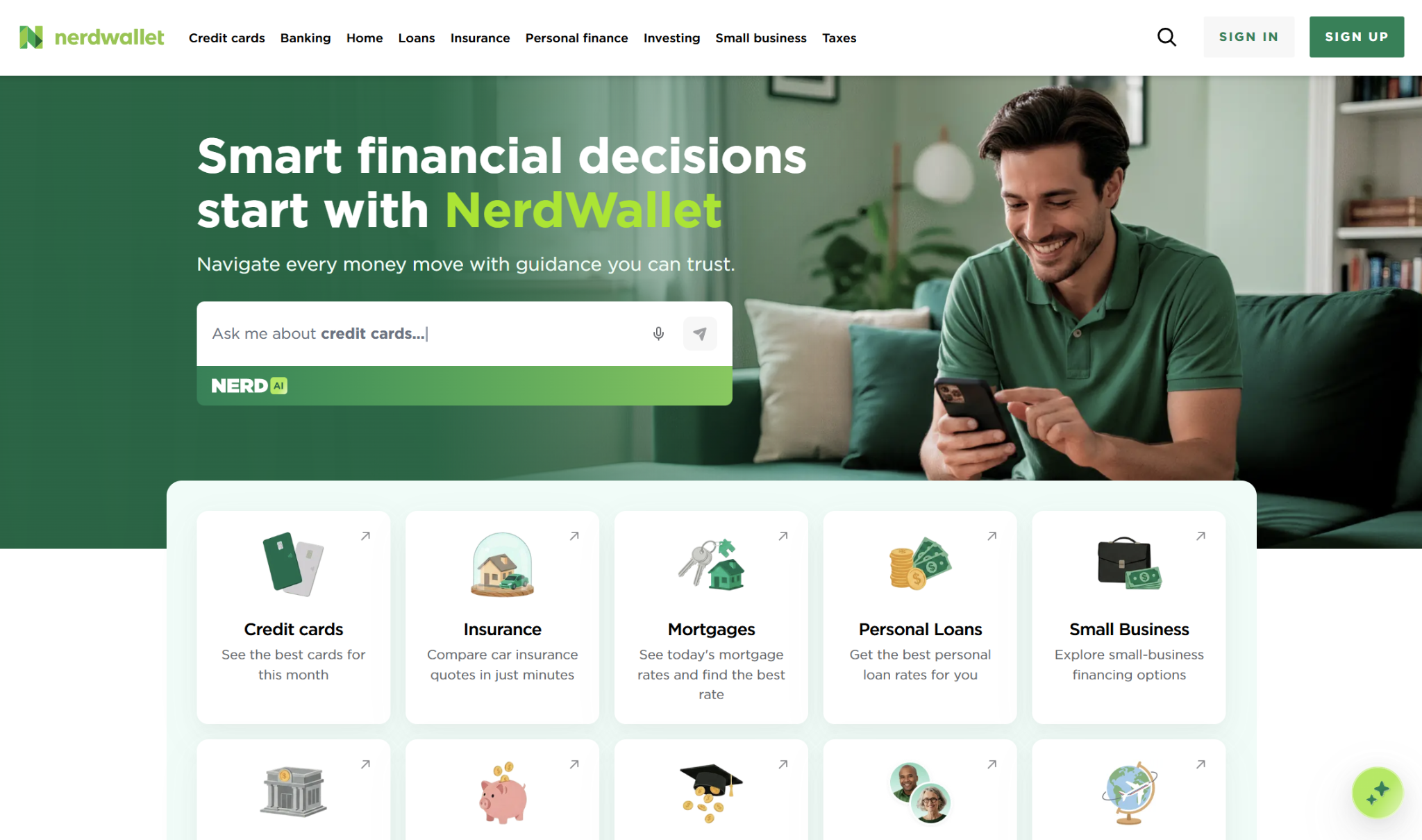
When on the hunt for a new financial product, a lot of people end up on NerdWallet. It’s one of the leading sites out there for comparing credit cards, savings accounts, checking accounts, CDs, mortgages, personal loans, auto loans, insurance policies, investment accounts, and more.
One area where NerdWallet stands out is with its strong editorial team. NerdWallet’s team rates and reviews many of the options listed, giving you a well-rounded view of each choice. And if you just need to learn more about personal finance in general, the site has plenty of helpful articles and calculators.
While NerdWallet is certainly a solid starting point for narrowing down your search, you’ll want to check out multiple sites to get a variety of perspectives.
How Financial Comparison Sites Work
Some comparison sites skew toward editorial reviews, while others adopt a marketplace-style approach. I would put NerdWallet in the editorial category, as you can browse its options on your own terms and read through its team’s reviews. The marketplace-style sites tend to be less review-driven, with a goal of getting you quotes quickly. They’re most useful once you’re done browsing and are in the decision stage.
However, the main reason to branch out from using NerdWallet exclusively comes down to how these sites make money. They partner with financial companies and earn commissions when users follow the links to their partners’ sites. Often, the relationships with partners can influence product rankings, but the best comparison sites maintain an honest approach and keep the end user in mind.
Because each comparison site has a different set of partners, it’s a smart idea to visit several before deciding. With that in mind, here are some of my top picks for the best sites like NerdWallet.
The Best Sites like NerdWallet: At a Glance
- BestMoney: Best for usability and quick comparison
- Finder: Best for cryptocurrency
- Forbes Advisor: Best for business products
- Bankrate: Best for mortgages
BestMoney: Best for Usability and Quick Comparison
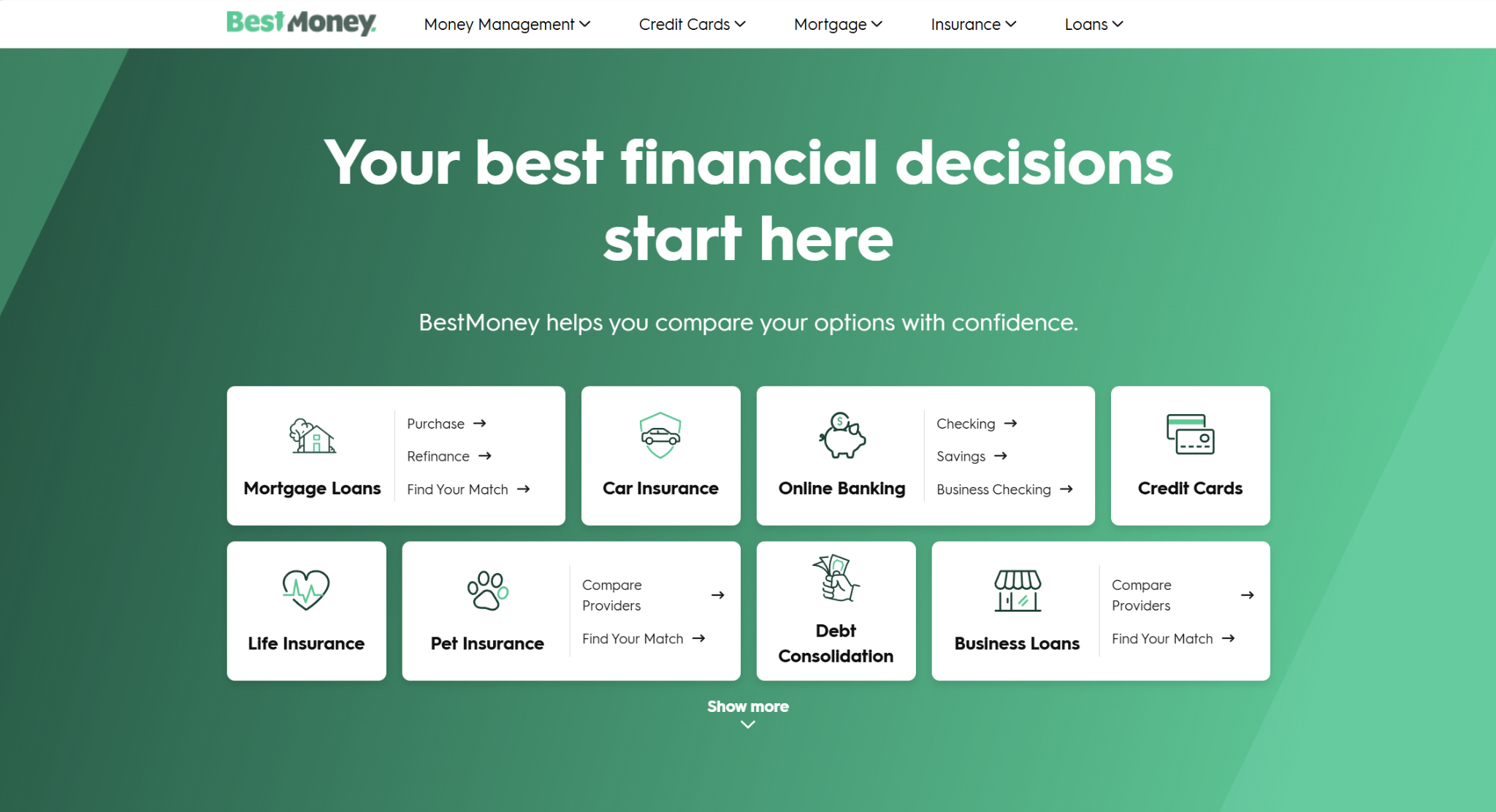
BestMoney has several things in common with NerdWallet: it covers many product categories, reviews several of the options listed, and has educational articles to read through. In many ways, I would describe it as a “simpler” version of NerdWallet because it is somewhat lighter in content. However, this gives it the edge when it comes to usability, as BestMoney makes it easy to click through and compare.
Product Coverage
BestMoney’s product coverage consists of:
- Credit cards
- Online banking (checking, savings, business checking)
- Insurance (car, life, pet, home, renters, travel, business)
- Loans (mortgage, personal, car, student, business)
- Debt relief programs
- Money transfer services
- Online stock brokers
- Gold IRAs
- Tax relief companies
Within each category, the number of options you’ll see will depend on the type of product. For instance, BestMoney showed me nine for mortgages, renters insurance, and pet insurance, while it presented eight options for savings accounts.
Ratings and Reviews
For most of the options listed, BestMoney assigns a rating and publishes a detailed review. The ratings are on a 10-point scale and are rounded to the nearest tenth of a point. While the methodology behind the rating can vary depending on the type of product, generally speaking, the overall score factors in a provider’s popularity, brand reputation, features, and benefits.
The reviews are comprehensive, including pros and cons and discussing features like fees, interest rates, rewards, security, customer service, the online experience, and the application process.
Educational Tools
While comparison is BestMoney’s main focus, it also has resources for learning more about personal finance as a whole. For the most part, these are in article form. The articles cover a variety of topics, such as the difference between a bank and a credit union, how many credit cards to have, and whether your employer’s life insurance is enough.
BestMoney also has some calculators, such as those for balance transfer savings, simple savings, CDs, life insurance coverage, and home affordability.
Pros
- User-friendly site
- Covers a wide range of product categories
- Detailed editorial reviews
Cons
- Limited number of product options per category
- No user reviews
- No true side-by-side comparison feature
Finder: Best for Cryptocurrency
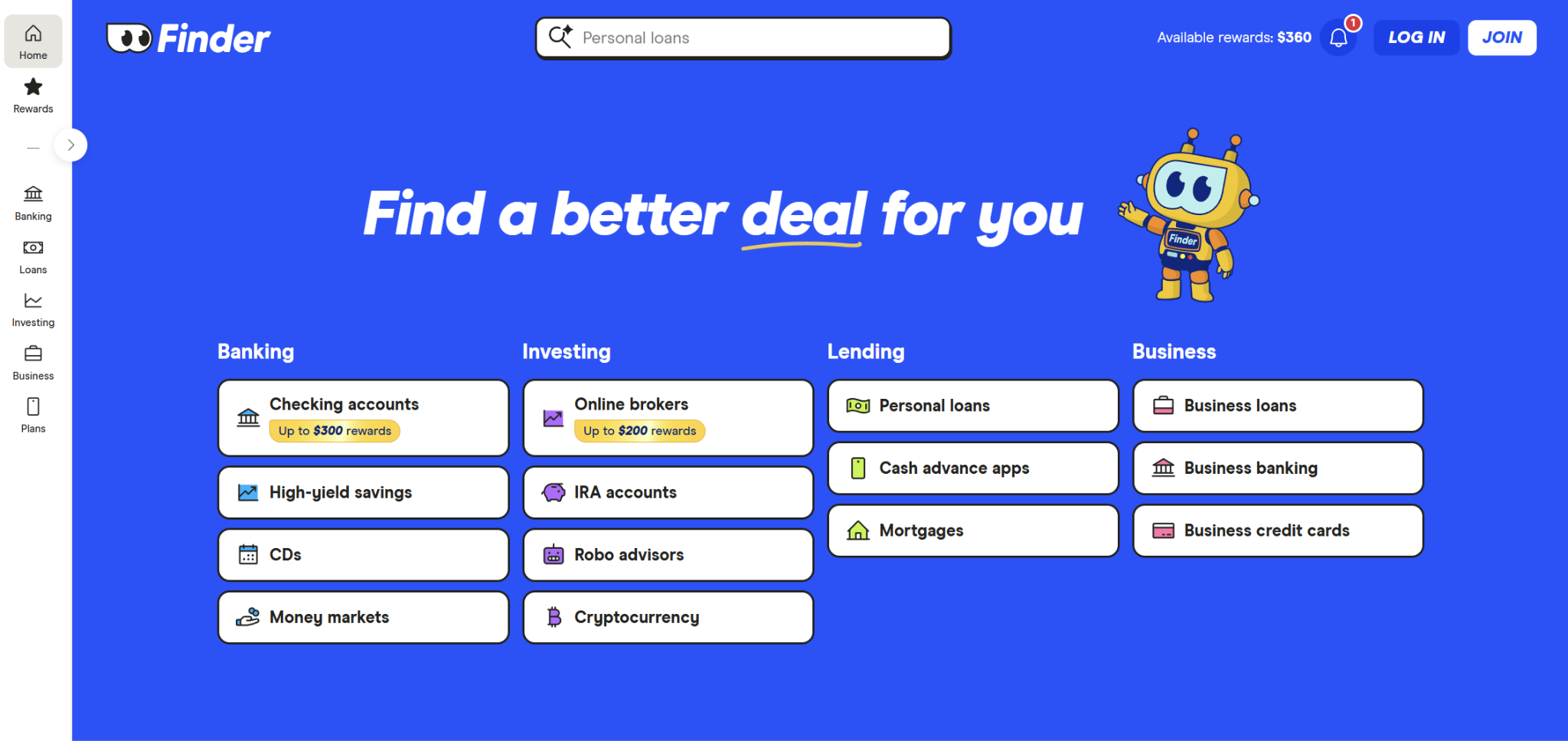
Finder is known for its Finder Rewards program, where you can earn cash-back offers when signing up for certain products. However, you don’t have to participate in Finder Rewards to use the rest of the site, which is all about comparison.
Product Coverage
Finder lets you compare providers in a range of product categories:
- Banking (checking accounts, high-yield savings, CDs, money markets)
- Investing (Online brokers, IRA accounts, robo advisors, cryptocurrency)
- Lending (personal loans, cash advance apps, mortgages)
- Business (loans, banking, credit cards)
- Credit cards
- Mobile phone plans
Finder gave me eight options for crypto exchanges, 18 for high-yield savings, and 51 for personal loans, so the number of choices you’ll get depends on the product category you’re exploring. For some of the lengthier lists, it comes in handy to use Finder’s side-by-side comparison tool, where you can compare up to four providers at a time.
Ratings and Reviews
Finder’s team assigns a Finder Score to its product options. The score is out of a maximum of 10 points and is rounded to the nearest tenth of a point. The site does a good job of showing you the underlying rating methodology for a particular category, breaking down the factors and their respective percentage weights.
The editorial reviews are fairly detailed, discussing items like pros, cons, fees, the application process, and who an option is best for. Finder also has a section for users to leave reviews and assign ratings on a five-point scale, although not all products currently have user reviews.
Educational Tools
Finder publishes in-depth guides pertaining to its financial products, such as breaking down the basics of traditional savings accounts, mortgage refinancing, and starter loans. However, not every product type has articles (such as stock trading apps).
The site also has calculators, like ones for compound interest, mortgages, debt consolidation, and cryptocurrency conversion.
Pros
- Includes cryptocurrency products
- Side-by-side comparison tool
- Publishes both editorial and user reviews
Cons
- Heavily promotes its rewards program
- Not all products have user reviews
- Can be difficult to locate articles and calculators
Forbes Advisor: Best for Business Products
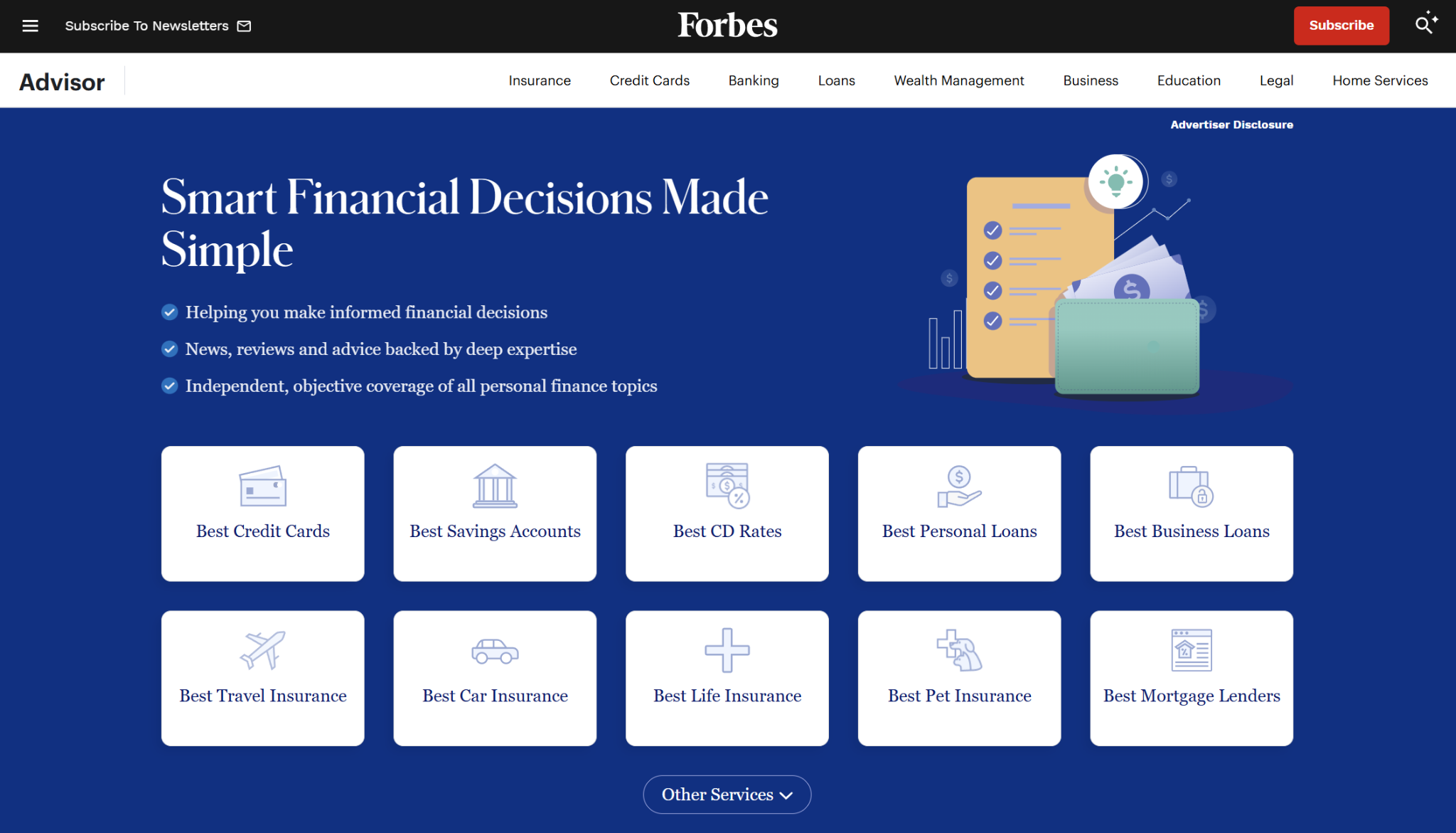
Forbes Advisor not only meets NerdWallet’s level of product coverage but exceeds it, helping both individuals and businesses compare the available choices. While it’s a strong resource for most anything that falls under the umbrella of personal finance, it goes beyond this, including detailed coverage of business tools.
Product Coverage
You can use Forbes Advisor to help you decide on providers in several areas, including:
- Insurance (car, travel, pet, life, home, renters, business, health)
- Credit cards
- Banking (savings, checking, CDs, money market)
- Loans (home equity, mortgage, personal, auto, student, business)
- Money transfer services
- Debt relief companies
- Investing (online brokers, investment apps, cryptocurrency exchanges)
- Retirement plans
- Tax software
Beyond straightforward financial products, Forbes Advisor has extensive resources on business software, such as VPNs, VOIP services, POS software, and payroll software. It also lets you compare products in the categories of education, legal, and home services.
The number of options given is fairly modest—it showed me 10 for high-yield savings accounts, 10 for credit cards, and five for car insurance.
Ratings and Reviews
Forbes Advisor comes at comparisons from an editorial angle, as each listing has a brief “Expert Review,” as well as a list of pros and cons. While the reviews are fairly short, they do a solid job of highlighting the main points. The team also tells you what each choice is best for. For example, when looking at high-yield savings accounts, some of the monikers are “best for savings tools,” “best for competitive APY,” and “best for beginners.”
In addition, the Forbes Advisor team assigns each listing a rating out of 5 possible points, rounded to the nearest tenth of a point. The methodology behind the rating varies depending on the category, but for all of them, the team takes the most important factors and weights them accordingly.
Educational Tools
Forbes Advisor has a vast article library, with several pages to click through. Examples of some of the personal finance topics addressed include the FAFSA, how to find a real estate agent, and using a personal loan to pay off credit card debt.
The site has plenty of calculators as well, which coincide with all the main product categories, like mortgages, credit cards, loans, banking, insurance, investing, currency conversion, taxes, and moving costs.
Pros
- Wide range of products covered
- Several financial calculators
- Transparent ratings methodologies
Cons
- Limited number of product options per category
- No user reviews
- Short expert reviews
Bankrate: Best for Mortgages
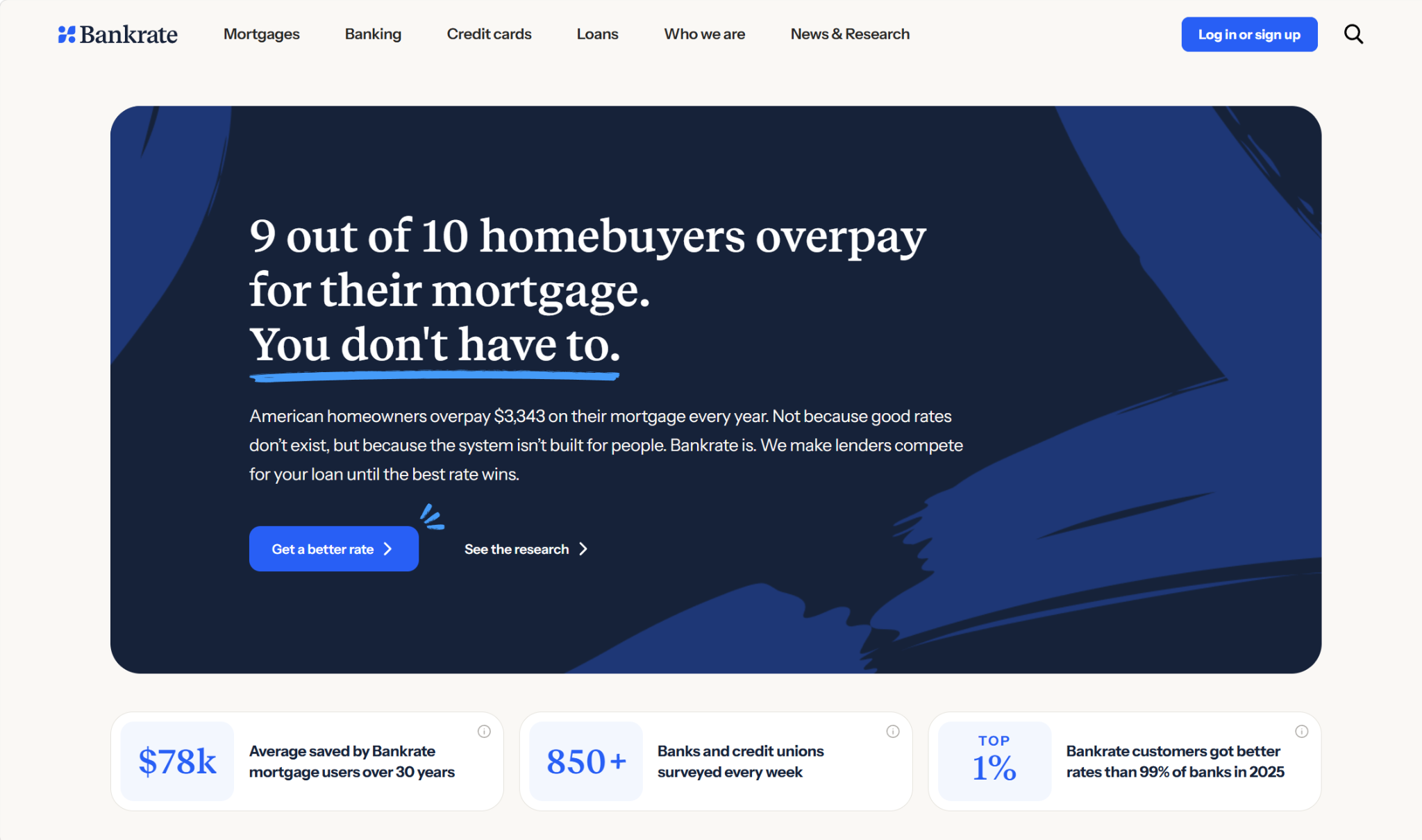
Bankrate is a comparison site that keeps data at the forefront. As you can tell by the name, it focuses heavily on rates, such as interest rates for savings accounts, mortgages, and loans. While the site’s home page is all about mortgages, you don’t have to be on the hunt for a mortgage in order to benefit from the site.
Product Coverage
You can use Bankrate to compare products in the following categories:
- Mortgages (purchasing, refinancing, HELOCs, home equity loans)
- Banking (checking, savings, CDs, money market, banks)
- Credit cards
- Loans (personal, auto, student, small business)
Within each category, it gives you a range of options to pick from, but the number varies by product. For example, Bankrate’s list of high-yield savings accounts has over 90 entries, but it only showed me five refinancing options.
Ratings and Reviews
Bankrate publishes editorial reviews for some, but all not all, of their products. For instance, there are lengthy reviews for many banks and credit cards, but not for mortgage lenders. The editorial reviews begin by showing the Bankrate Score out of five stars, and then they dive into pros, cons, and features, which vary by product.
Bankrate also lets users submit their own ratings and reviews. They can assign star ratings out of five and write about their experience.
Educational Tools
For those wanting to increase their financial literacy in general, Bankrate has guides covering the basics of mortgages, credit cards, savings, and loans. Some of the topics addressed include first-time homebuyer programs, cash-out refinancing, balance transfers, and how to get a personal loan.
Bankrate has interactive tools as well, such as calculators for mortgages, amortization, refinancing, savings, CDs, personal loans, and auto loans. Plus, the site regularly publishes news and research, with its Bankrate Data Center dedicated to rate information, surveys, and other data studies.
Pros
- Great for comparing mortgages
- Highly data-driven
- Includes user reviews
Cons
- Can’t use it to compare insurance providers
- Some products are unreviewed
- Some product categories have limited options
Which is the Best Comparison Site like NerdWallet?

If you’ve been happy with using NerdWallet to research products but are interested in seeing what similar sites are out there, there are plenty of strong options. Some of my personal favorites are BestMoney, Finder, Forbes Advisor, and Bankrate.
However, these sites aren’t all the same, and they come with their own unique strengths and weaknesses. In some ways, I’d position BestMoney as “NerdWallet-lite.” Its product coverage is extensive, but it’s lighter on editorial content, which actually gives it the edge for usability and quick research. If you want more options, though, I’d direct you to Finder. What stands out about Finder is its broad cryptocurrency coverage, which isn’t something that all comparison sites address. Of all these sites, Forbes Advisor probably covers the most product categories, so you’re likely to find what you need there. This is especially true if you’re looking for business products. And while it can’t help you with insurance, Bankrate is one of the best resources for mortgage comparison.
But regardless of the type of product you’re shopping for, I’d suggest visiting several sites to get a more comprehensive view of the financial landscape.