


- How to Compare Money Transfer Services - October 14, 2026
- The Best Sites Like NerdWallet for Comparing Financial Products - September 18, 2026
- The Best Business Loan Comparison Sites - August 29, 2026
Policygenius is one of the most popular sites for researching insurance, including life, home, auto, and disability insurance. You can use the site to compare rates and providers, but it goes beyond comparison. It’s an independent insurance broker, so if you find an option that suits your lifestyle, you can buy a policy through them.
While Policygenius is an excellent resource, there are circumstances where you might prefer another site instead. For example, certain insurance types like health, pet, travel, or business insurance aren’t within Policygenius’s scope, so you’d have to go elsewhere to learn more about these policies.
Also, while the all-in-one nature of Policygenius being both a comparison tool and a broker can be convenient, maybe you find this too salesy and want something that’s strictly for research. Even if you’re fully satisfied with Policygenius, it’s never a good idea to rely solely on one site for research.
Here are some of my top picks for Policygenius alternatives.
Best Policygenius Alternatives: At a Glance
- BestMoney: Best for quick research and usability
- Insurance.com: Best for data-driven research
- Insurify: Best for user ratings and reviews
- The Zebra: Best for auto insurance
- Forbes Advisor: Best for expert ratings and reviews
BestMoney: Best for Quick Research and Usability
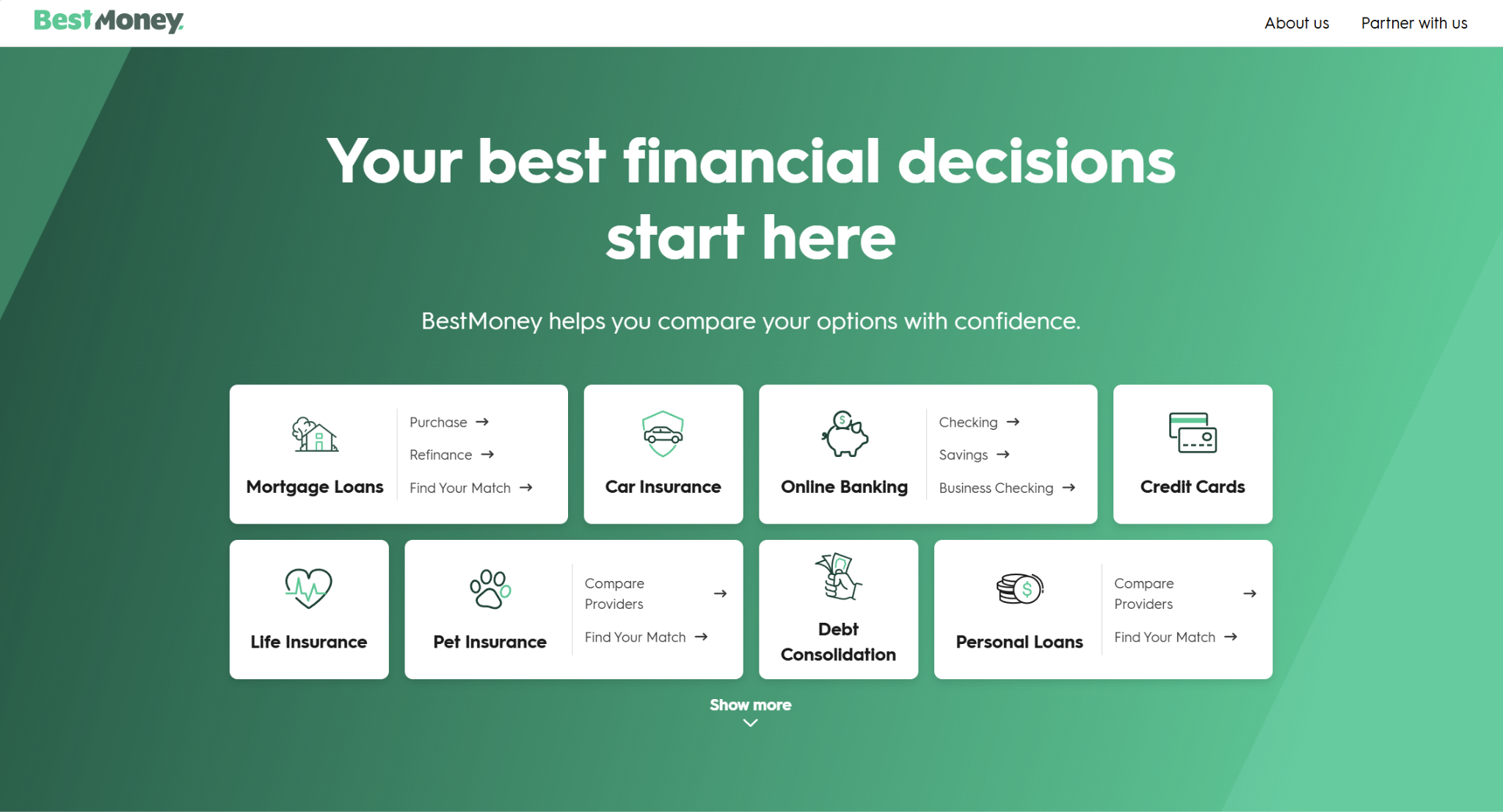
BestMoney is similar to Policygenius in that you can use it to compare insurance options, but it’s not a broker; it’s strictly a comparison site. Also, Policygenius is wholly dedicated to insurance, but BestMoney goes beyond that, providing resources on a range of financial products.
Product Coverage
BestMoney lets you compare options for car, life, pet, renters, home, travel, and business insurance. You’ll click on the type of insurance you’re looking for, and it will give you a list of choices. Some insurance types, like pet or life insurance, bring you straight to the list. However, car and home insurance prompt you to take a short quiz to gather information before showing you a list.
For most categories, BestMoney lets you filter through the list of options to hone in on those that fit your requirements. For example, you can filter life insurance providers based on your age range and annual income. For business insurance, you’ll filter depending on whether you’re looking for general liability, professional liability, workers’ compensation, business owner, or commercial auto insurance.
Ratings and Reviews
For most insurance companies, BestMoney’s team assigns scores out of 10 stars and has detailed reviews to read through. The scores usually take into account a provider’s popularity, brand reputation, and plan features. While the scope of the reviews differs depending on the insurance type you’re looking at, they all start with a brief list of pros and cons, and they tend to discuss the plan features and rates, application process, and customer experience.

Getting a Quote
Once you think you’ve decided on an insurance company, it’s time to get a quote. Something to note is that, since BestMoney isn’t a broker, you can’t get a quote directly through them, and you can’t compare multiple quotes all on one screen. Instead, you’ll have to click the “View Rates” button, which brings you to the provider’s site to get a quote.
Financial Education
If you want to learn more about insurance in general before shopping around, you can use BestMoney for that, too. Their article library has plenty of posts for learning about common topics, such as determining how much life insurance you need, how to file a renters insurance claim, and what pet insurance covers.
Pros
- Broad coverage of financial products and insurance
- Insurance company filtering
- Scores and reviews of insurance companies
- Not a broker, so less inherent bias
Cons
- No insurance calculators
- Can’t purchase a policy through the site
- Have to navigate to carrier sites for quotes
Insurance.com: Best for Data-Driven Research
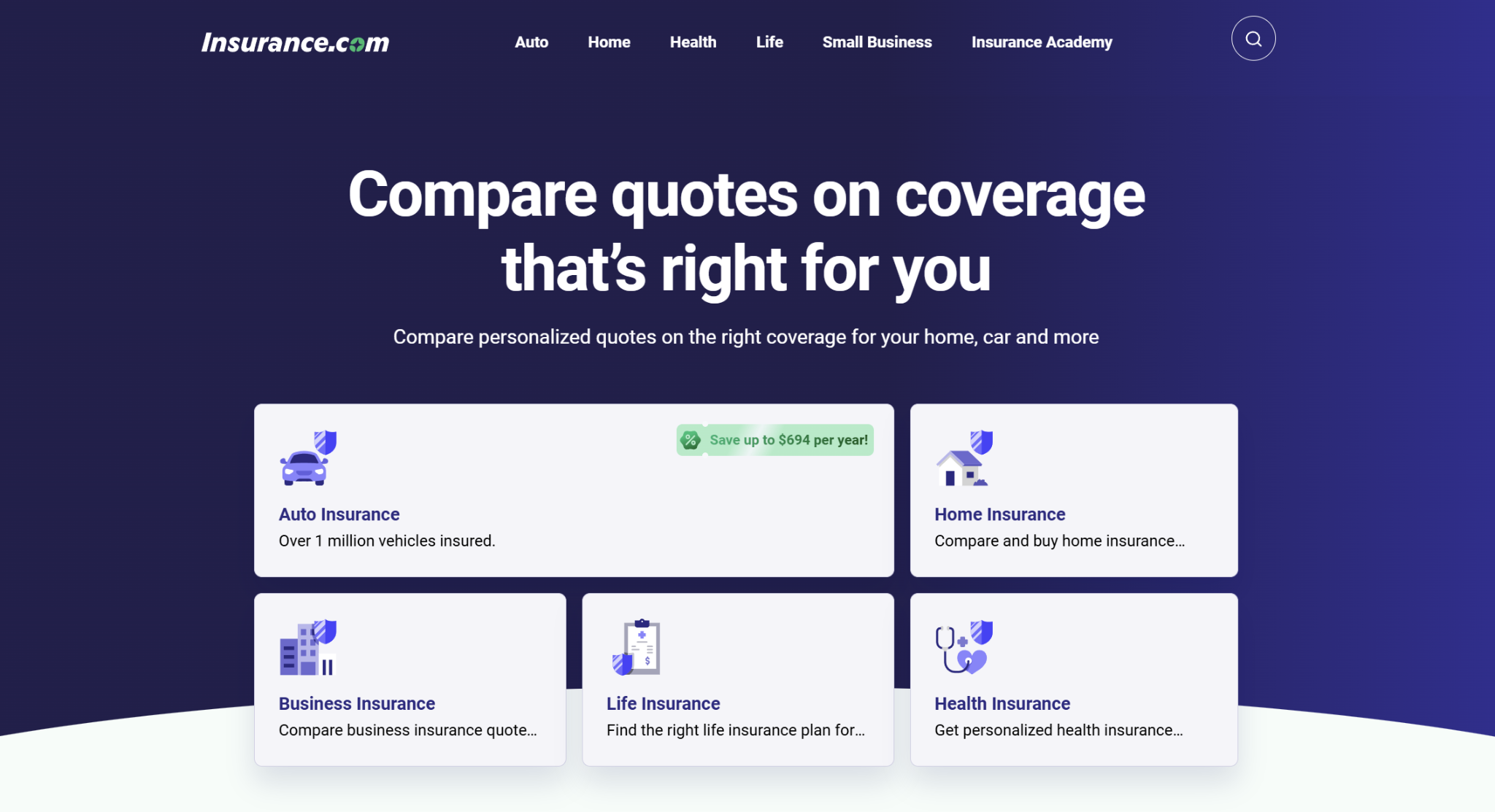
As the name implies, Insurance.com is all about insurance. It doesn’t cover any other types of financial products. Like BestMoney, it’s not a broker and is focused entirely on comparison and education.
Product Coverage
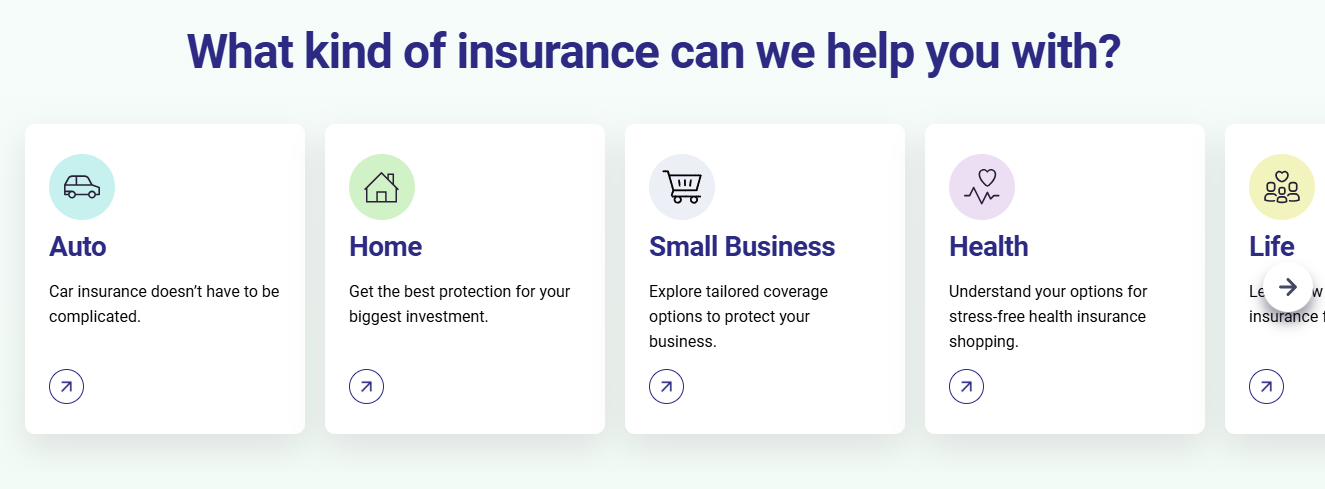
There are five main categories that Insurance.com covers: auto, home, health, life, and small business insurance. Within each category is a list of the “best” insurance providers. These are curated lists of the top companies, and they’re strictly informational. You can’t filter through them or get quotes on these pages.
However, there are filters (and sometimes brief forms to complete) when you hit the “Compare Quotes” button. Depending on the insurance type, you can filter by insurance type, age range, and credit rating.
Ratings and Reviews
Where Insurance.com excels is with its thorough ratings and reviews of insurance companies. On the “best” lists that I mentioned previously, the top companies are ranked, and you can see how the ranking changed between this year and last. It also shows you two scores for each company, both out of five stars: an overall rating and a customer satisfaction rating.
The scores aren’t random or crudely determined, either. Insurance.com’s methodology is transparent, incorporating factors like survey responses, financial strength data, and consumer complaints.
Getting a Quote
The process of getting a quote is nearly identical to BestMoney’s. Once you’re on the “Compare Quotes” page for the type of policy you’re shopping for, you can click a button next to each provider to navigate to their site, which will prompt you to fill out your information.
Financial Education
Aside from being a comparison tool, you can also visit Insurance.com to brush up on your insurance knowledge. Their Insurance Academy publishes guides on the basics of auto, home, life, health, motorcycle/RV, and business insurance.
Most insurance categories also have calculators you can play around with to get an idea of the amount of coverage you need and the premiums you could be facing. Additionally, the site has several charts with rate information, such as car insurance rates by state or the average renters’ insurance rates.
Pros
- Insurance calculators
- Insurance carrier ranking lists
- Scores and reviews of insurance companies
Cons
- Limited number of insurance carriers
- Can’t purchase a policy through the site
- Have to navigate to carrier sites for quotes
Insurify: Best for User Ratings and Reviews
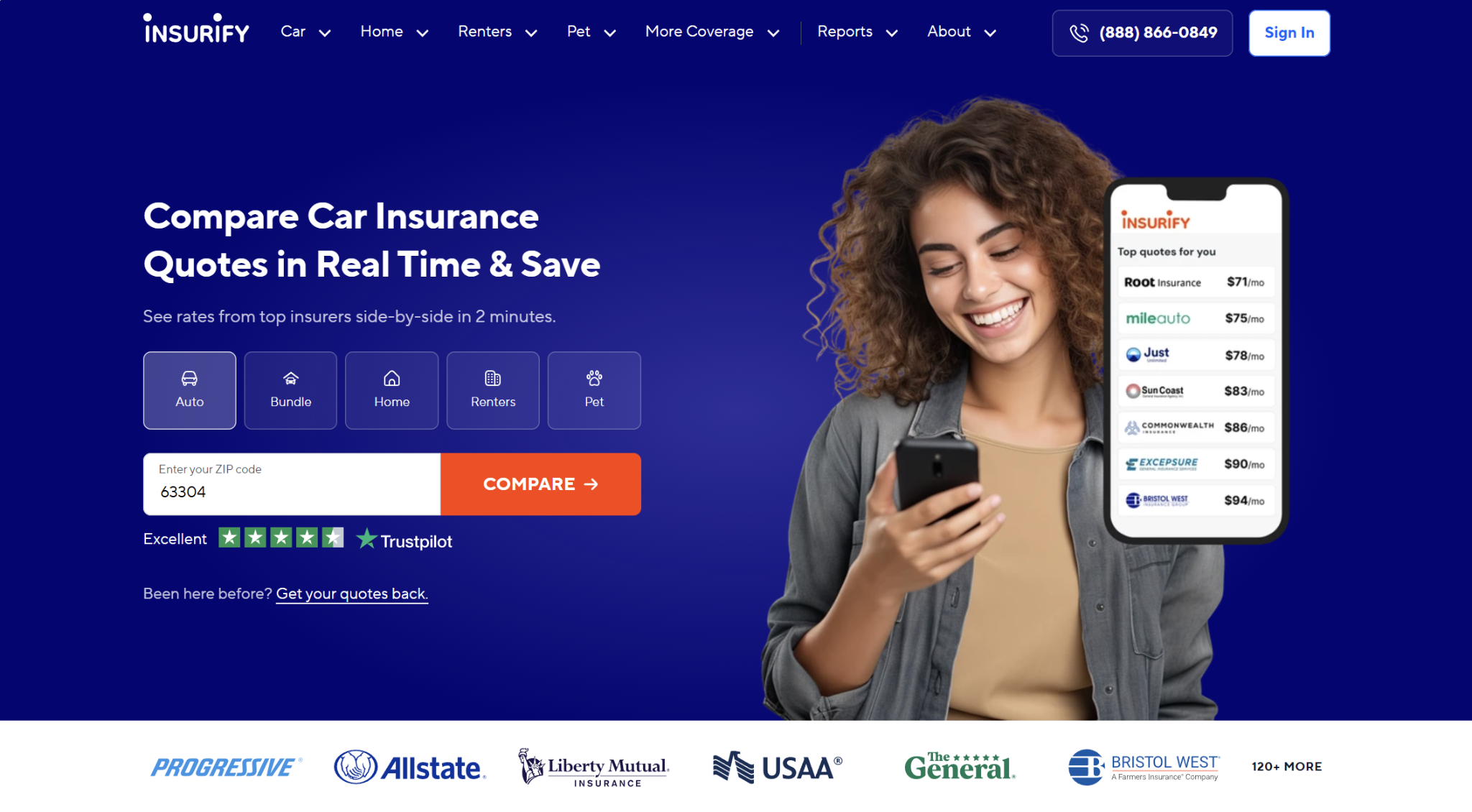
Insurify is one of the closest options to Policygenius in that it’s both a comparison tool and an insurance agency. So, it’s an ideal platform if you want to research and buy a policy all at once.
Product Coverage
Insurify is fully devoted to insurance. You can visit the site to learn more about a range of insurance products, including car, home, renters, pet, business, travel, life, health, and device insurance. You can’t easily filter through them, as most of the comparison comes only when you begin the process of getting a quote.
However, some of the insurance types have tools for quick comparison across a selection of the top companies. For car insurance, the site presents an overview of five providers side-by-side, letting you compare average prices and ratings. If you’re looking at pet insurance, you’ll see a comparison table with the average quote for dogs, the average quote for cats, the reimbursement percentage, the payout limits, and deductibles.
Ratings and Reviews
Insurify has ratings and reviews for some of the providers presented. The site relies heavily on user feedback, but it also assigns Insurify Quality scores to car insurance companies, considering variables like financial strength, customer satisfaction, affordability, customer support, and availability. Insurify’s team publishes reviews as well, which explore many of these same characteristics.

Getting a Quote
To obtain quotes, you’ll have to fill out a form for the specific type of insurance coverage you’re looking at. If you’re shopping for car insurance, you’ll have to provide the make and model of your car, and for home insurance, you’ll need to provide details on your property. You can also call the company to speak with an agent.
Financial Education
If you want to read up on insurance but aren’t ready to purchase, you can use Insurify for your research, too. The site has plenty of articles discussing topics like how much home insurance coverage you need, how to cancel a car insurance policy, and how pet insurance works. There’s also average rate data to explore, state-by-state information, and a car insurance calculator to estimate your monthly premium.
Pros
- Includes user ratings and reviews
- Broad coverage of insurance types
- Can purchase a policy through the site
Cons
- Potentially confusing UI
- No filtering
- Pushes you to provide your personal details
The Zebra: Best for Auto Insurance
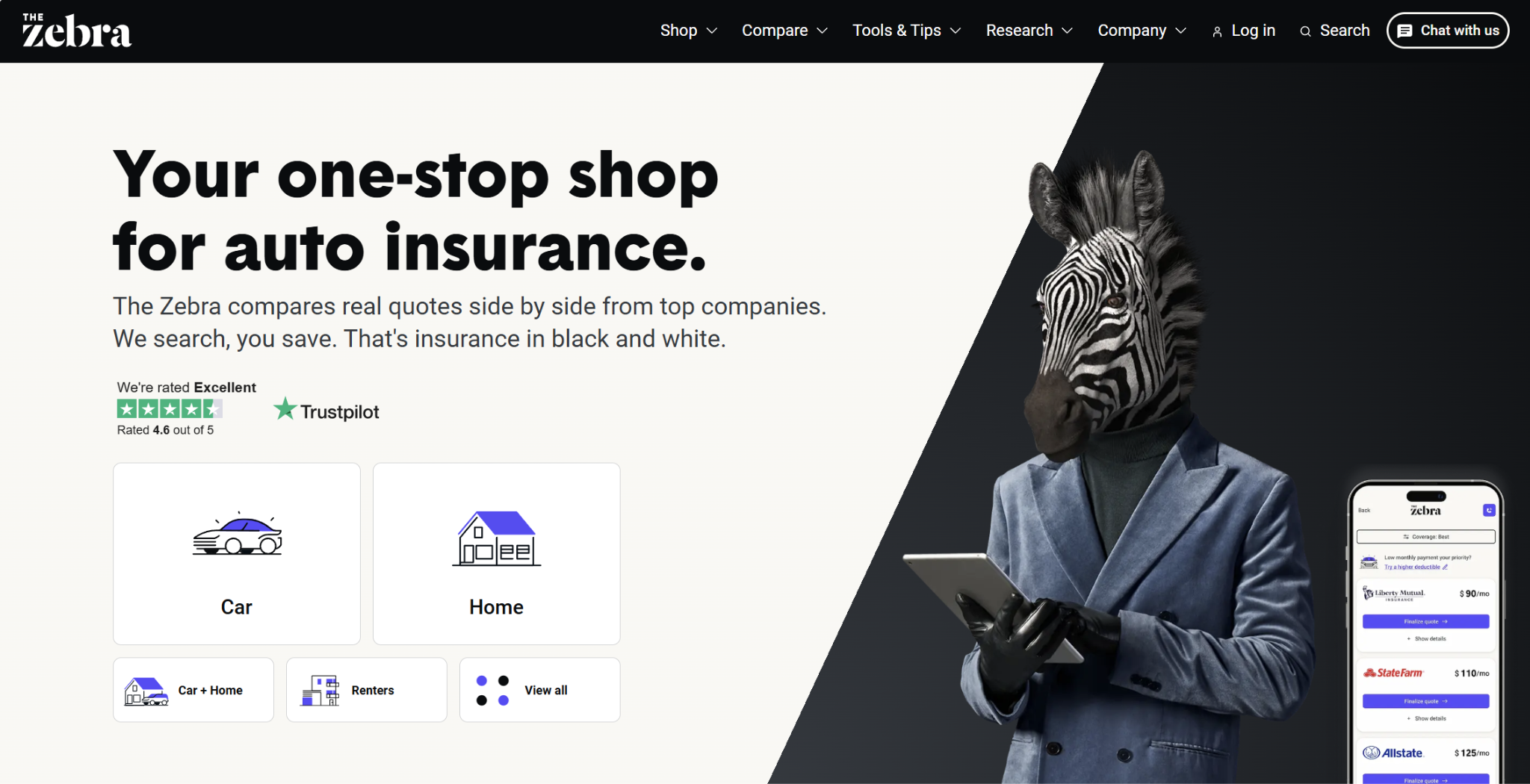
The Zebra is an insurance comparison tool that’s also an insurance agency, so it operates in the same family as Policygenius and Insurify.
Product Coverage
The first thing you’ll see on The Zebra’s site is that it’s “Your one-stop shop for auto insurance,” and while car insurance is certainly one of its main focuses, that’s not the only type of insurance it helps you compare. You can also use The Zebra to research home, renters, life, and pet insurance. In addition, they have some resources on more niche insurance types like boat, ATV, and motorcycle insurance.
You can’t conduct an in-depth comparison of insurance providers without completing a form to get personalized quotes, so the site doesn’t use filters. However, even without providing your personal details, you can still view basic information like a company’s average monthly premium.
Ratings and Reviews
The Zebra reviews many providers, especially for car and home insurance. The reviews show you The Zebra’s overall rating out of five stars, which take into account both pricing and user experiences. The car insurance reviews tend to be more detailed than those for home insurance, discussing pros and cons, pricing, discounts, coverage options, and customer support.
Car insurance providers are also given subscores beneath the overall score, including those for customer service, the claims experience, the digital experience, and trust and reliability. There’s a tool you can use to compare The Zebra’s scores for up to three carriers side-by-side.
Getting a Quote
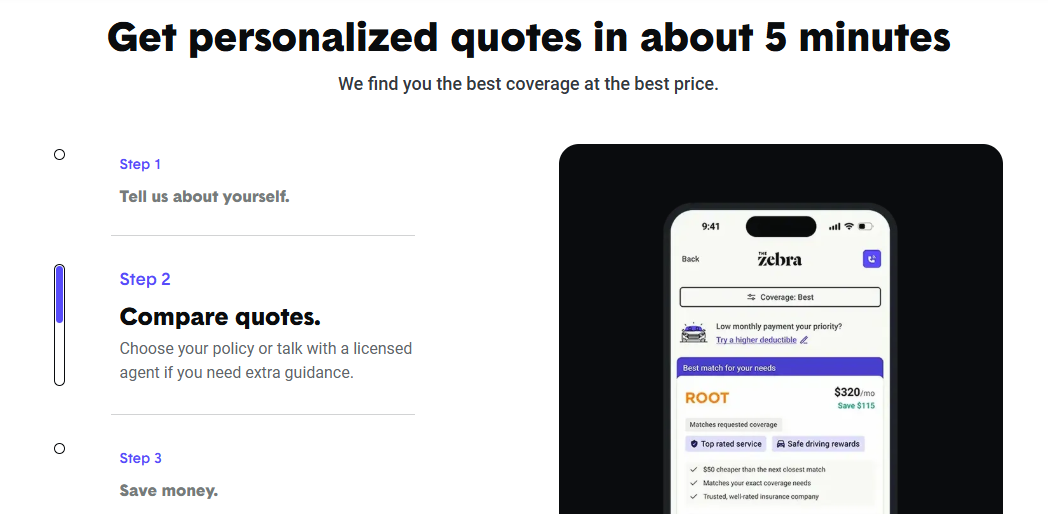
To get a quote on The Zebra’s site, you’ll click on the type of insurance you need from the home page. For some insurance types, like car and home, you’ll be prompted to fill out a form with your details. Other insurance types don’t provide a form and instead direct you straight to a single insurance company. Examples are pet insurance, which directs you to Embrace, and motorcycle insurance, which directs you to Progressive.
Financial Education
For those who aren’t yet ready to buy a policy, you might benefit from using The Zebra as an educational tool. The site publishes in-depth reports on the current state of auto and home insurance, and it also has a resource center filled with informative articles.
Some of the topics covered in the resource center include what happens when you file a homeowners insurance claim, understanding how depreciation affects insurance payouts, and factors affecting car insurance premiums.
Pros
- Side-by-side car insurance comparison
- Broad coverage of insurance types
- Can purchase a policy through the site
Cons
- Potentially confusing UI
- No filtering
- Some insurance types only give you one carrier option
Forbes Advisor: Best for Expert Ratings and Reviews
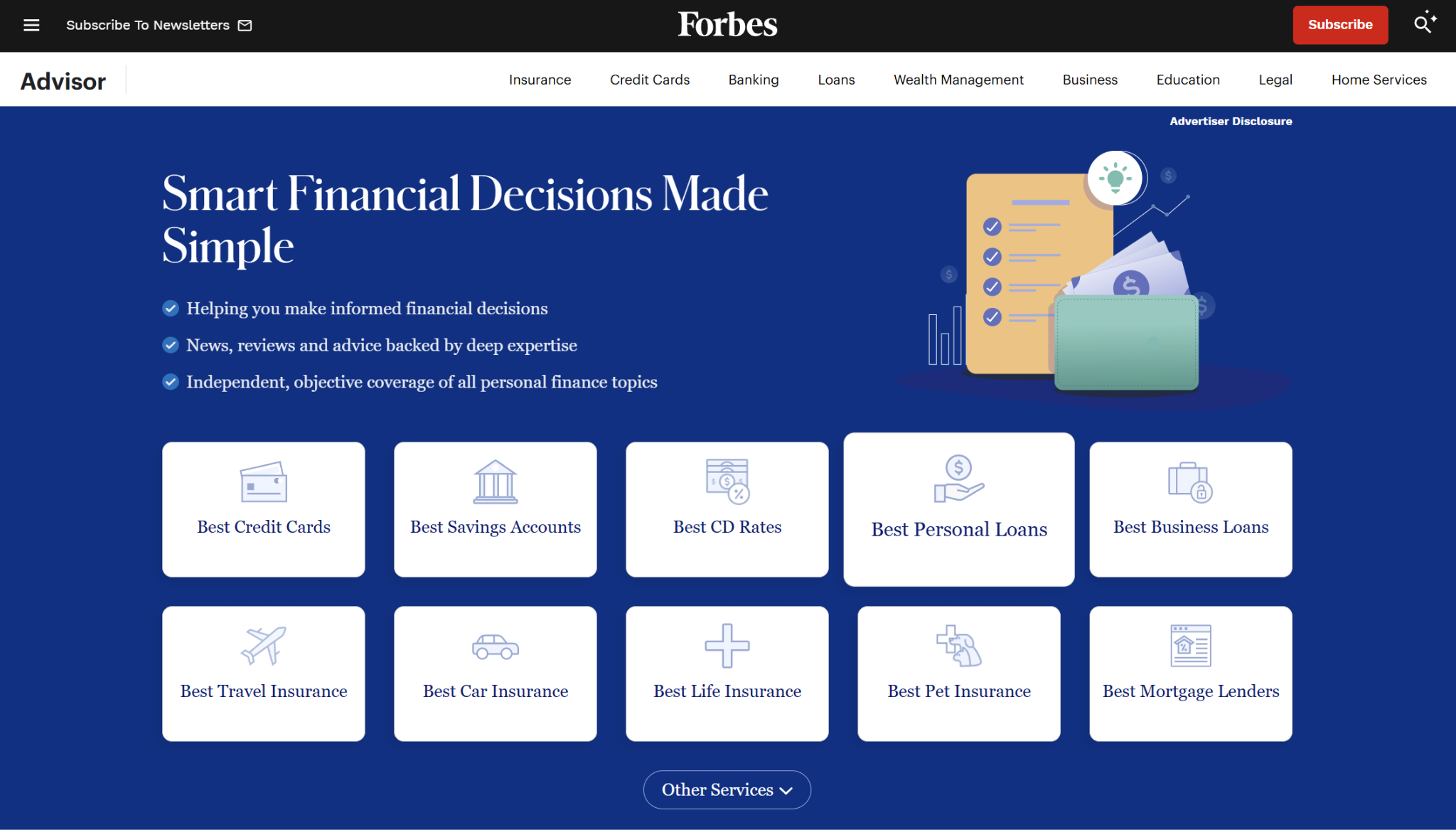
You already know Forbes as a finance and business news site, but you may not be aware that it has a dedicated section for comparing financial products. Forbes Advisor covers all sorts of financial products, not just insurance.
Product Coverage
While Forbes Advisor can also help you research credit cards, banking, loans, and investing, I’ll be focusing on insurance here. Forbes Advisor covers several insurance types: car, travel, pet, life, home, renters, business, and health.
Each type has its own dedicated “best” list that contains a selection of some of the top insurance carriers. There aren’t any filters to use to narrow down your options, but that’s not much of an issue since the lists of carriers are fairly abbreviated anyway.
Ratings and Reviews
Each carrier that Forbes Advisor shows you has a rating out of five stars, as well as an expert review. Some of the reviews are fairly short, while others are lengthier, going into detail on plan information. There are pros and cons lists also. Forbes Advisor’s five-star rating system considers several variables, which are tailored toward the specific product type. Pricing and customer experience are a couple of the strongest determinants of a carrier’s score.
Getting a Quote
If you’ve spent some time on Forbes Advisor and want to purchase a policy, you can start by getting a quote. Forbes Advisor isn’t an insurance broker; it’s solely a research tool, so you can’t obtain quotes directly through them. Instead, you’ll fill out forms to get quotes from Forbes Advisor’s partners.
Financial Education
Besides providing plenty of information on specific carriers, you can also visit Forbes Advisor to read through educational insurance content. For each insurance category, Forbes Advisor publishes buying guides and explainers. You can use these to brush up on a variety of topics, such as pet insurance deductibles, lowering car insurance premiums, and term vs. whole life insurance.
Pros
- Broad coverage of insurance types
- Scores and reviews of insurance companies
- Detailed educational insurance content
Cons
- Potentially distracting ads
- No user reviews
- No filters
So, What’s the Best Alternative to Policygenius?
If you’re on the hunt for a new insurance policy, the good news is that there are plenty of sites that can help you along the way. Policygenius is one of the most popular names in this space, but there are times when it simply won’t get the job done, such as if it doesn’t have the insurance type you’re looking for.
There isn’t one single site that covers all possible use cases, since they all have different product coverage and their own strengths and weaknesses. The best strategy is to use multiple sites during your search, since they all shine in different ways.
For example, if you want something quick and easy to use, you might prefer BestMoney. Or, if your focus is on car insurance, The Zebra might have the edge for you. It all depends on your specific goals and preferences.