


- How to Compare Cash Back Credit Cards: Balancing Rewards and Spending - October 27, 2026
- The Best CardRatings Alternatives for Comparing Credit Cards - October 27, 2026
- How to Compare Money Transfer Services - October 14, 2026
Founded in 1998, CardRatings has long been a trusted resource for consumers to turn to when searching for a new credit card. It lets users filter through its database of over 850 cards to find the best fit based on interest, cash back, credit score range, student or military status, and more. Outside of comparison, the site publishes comprehensive editorial reviews and has several interactive tools and calculators.
However, it’s important not to rely too heavily on any one site when making financial decisions. If you want to venture beyond CardRatings to get a better view of the credit card landscape, there are plenty of solid options to explore.
CardRatings Alternatives: At a Glance
| Best For | Ratings and Reviews | Tools and Guides | Mobile App? | |
| NerdWallet | Financial education | Editorial | Side-by-side comparison, CardFinder quiz, articles, calculators | Yes |
| BestMoney | Quick comparison | Editorial | Articles | No |
| WalletHub | In-depth card research | Editorial and user | Side-by-side comparison, CardAdvisor quiz, articles, calculators | Yes |
| The Points Guy | Travel cards | Editorial | Side-by-side comparison, CardMatch quiz, points valuations, awards vs. cash calculator, articles | No |
| Credit Karma | Consumer data insights | Editorial and user | Articles, data insights, calculators | Yes |
NerdWallet: Best for Financial Education
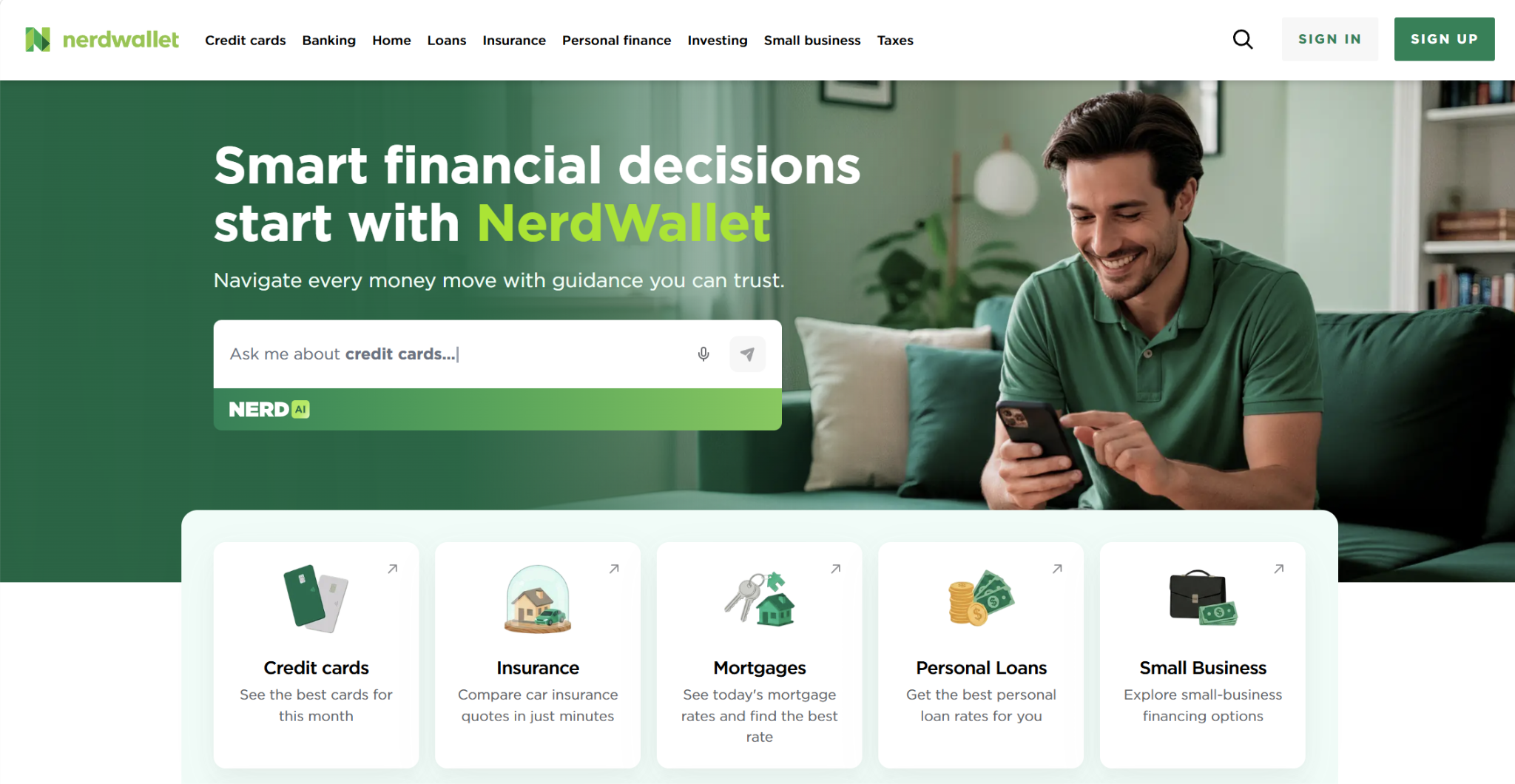
NerdWallet is one of the leading sites for comparing financial products across insurance, banking, investing, credit cards, and other categories. Users can evaluate cards against each other, read editorial reviews, and get matched with suitable options. While it is known for its website, NerdWallet also has a mobile app. The app is mainly for tracking personal finances and investing, although credit card reviews are accessible there as well.
Credit Card Database
NerdWallet compiles several lists of the best credit cards. Created by the editorial team from a database of over 400 cards in total. These lists encompass the best options overall, cash back, travel, etc. Plus, you can filter by your credit score range (bad, fair, good, excellent, or no credit), and you can explore business cards if desired.
Ratings and Reviews
NerdWallet developed a formula to determine the rating, and assigned a score out of five stars to each card. They emphasize using different formulas for different categories. For the star ratings, there are eight card categories: cash back, general travel, balance transfer, branded airline, credit builder, college student, and small business. You can also read detailed reviews of cards you’re interested in, with reviews covering rewards, sign-up bonuses, fees, APRs, and additional benefits.
Guides and Tools
For further analysis beyond the curated lists, the site has a side-by-side comparison tool, where you can view features for up to three cards at a time. You can also complete the CardFinder quiz to be matched with personalized recommendations. The quiz begins by asking about the type of credit card you’re looking for, such as travel or cash back, and it follows up with some more questions before presenting the results.
If you want to deepen your credit card knowledge, you can read through NerdWallet’s extensive credit card article library. It covers topics including sign-up bonuses, combining points, building credit, and getting a higher limit. There are also interactive calculators for balance transfer savings and credit card interest.
BestMoney: Best for Quick Comparison

In many ways, BestMoney can be seen as a scaled down version of NerdWallet, but in a good way. Like NerdWallet, its product coverage spans a range of categories, with credit cards being only one of them. The site is web-only, with the interface being simpler to navigate with cleaner features and fewer extras.
Credit Card Database
BestMoney doesn’t publish the exact number of credit cards presented on its site. There is an overall “Our Best” list, alongside lists for specific categories like cash back, balance transfer, travel, rewards, no annual fee, 0% APR, and business cards. You can also view cards by issuer.
The lists are on the shorter side. This may not be ideal if you want to perform in-depth research, it is a solid choice for quick comparisons. For each card, it presents the welcome bonus, rewards rate, annual fee, recommended credit score, regular APR, and intro APR. It gives you a good starting point.
Ratings and Reviews
The BestMoney team rates and reviews credit cards. There are two distinct scores to consider: the BestMoney score, which combines a card’s anticipated engagement with editorial insight, and the editor’s review. The BestMoney score is on a five-star scale, while the editor’s review is out of ten points.
When reading the full editorial review, you’ll also see subscores for fees, APR, security, customer service, and the online experience, all of which are discussed in greater detail. Plus, there are brief pros and cons lists for grasping the main takeaways.
Guides and Tools
BestMoney regularly publishes educational guides on credit card topics. These topics include balance transfers, online shopping security, credit card refunds, business cards for freelancers, and minimum payments. There are additionally some guides that discuss how to figure the value of welcome bonuses, credit card interest, and balance transfer savings into long term credit card advantages. Unfortunately, there aren’t any interactive tools to perform these calculations.
WalletHub: Best for In-Depth Card Research

Well known for its credit-building and personal finance app, WalletHub’s site is also an excellent resource for comparing financial products and professionals like financial advisors and real estate agents. It has an extensive product database, making it a good match for those wanting to compare as many options as possible.
Credit Card Database
WalletHub’s team curated its list of cards after reviewing over 1,500 in total. The resulting list is still lengthy, although the site’s filtering system makes it easy to narrow down. You can filter by the card type (personal, business, student), your credit score, the card network, the balance transfer fee, and other characteristics. The site clearly presents each card’s annual fee, rewards rate, bonus offer, and credit score.
Ratings and Reviews
WalletHub rates credit cards on a five-star scale, which factors in the editor’s rating, user reviews, and market comparison. Then, there are subscores for the fees, rewards, cost, and other features. The site displays user ratings and reviews as well, although not every card has been reviewed. User ratings are out of five stars, and users can support their rating by submitting a short comment.
Editorial reviews are more detailed. They discuss both the benefits and drawbacks of the fees, APRs, credit requirements, and other factors.
Guides and Tools
If you have specific cards you want to compare, you can view features for up to seven at a time through WalletHub’s side-by-side comparison tool. To receive a personalized credit card recommendation from WalletHub’s 100+ partner cards, you can complete the CardAdvisor quiz.
WalletHub has several calculators, covering balance transfer savings, interest, credit card payoff, and minimum payments. If you want to brush up on your credit card knowledge, you can read through some of WalletHub’s financial education guides. The information ranges in topics from paying your credit card bill to increasing your credit limit and rebuilding your credit.
The Points Guy: Best for Travel Cards

The Points Guy falls midway between a news site and a comparison site. It reports on the latest developments in the hotel, credit card, and airline industries, yet it also lets you dive deep into credit card characteristics and evaluate them against each other. The website specializes in travel cards; they provide comparison and research for other card types as well.
Credit Card Database
The Points Guy gives you a wide selection of credit cards, though you can filter to view the best overall. Besides travel and airline cards, there is also access to rewards, business, and cash back credit cards. One thing this website has is even more specialized categories such as card issuer, certain types of purchases, and more. For each card, The Points Guy tells you who it is best for, along with the intro offer, earning rate, and annual fee, if any.
Ratings and Reviews
Many of The Points Guy’s credit cards have editorial reviews. The reviews start off with a quick overview of the pros and cons, followed by a discussion of benefits, rewards, and potential downsides. Card ratings can reach a maximum of five stars, and the team weighs the perks, user experience, and annual fee, among other variables.
Guides and Tools
If you’d like, you can compare up to three cards side-by-side. There’s also a CardMatch tool to connect you with personalized card recommendations based on the types of rewards you’re seeking and your spending habits. The Points Guy also stands out for its points valuations, which are updated monthly. It values credit card points and miles, Bilt points, airline points and miles, and hotel points. Along those same lines, there is an awards vs. cash calculator for both airlines and hotels.
The Points Guy also has credit card guides, the main ones being a beginner’s guide to credit cards, a credit score guide, and a credit utilization guide.
Credit Karma: Best for Consumer Data Insights

Now owned by Intuit, Credit Karma helps users manage their finances and progress on their credit-building journeys. It’s popular for its mobile app, though its website also has plenty of features to explore. You can use Credit Karma to compare products like credit cards, personal loans, auto insurance, home insurance, mortgages, and bank accounts.
Credit Card Database
When comparing credit cards on Credit Karma, you can view the editors’ list of the best overall cards. If you would rather, you can filter by credit score, rewards, annual fee, etc. In total, they have 175 credit cards to compare.
Ratings and Reviews
Credit Karma reviews several of its credit cards, diving into the pros and cons, as well as giving you an idea of who it is best for. It also presents you with potential alternatives in case the card in question isn’t the right fit. The editorial team doesn’t assign ratings, but you can view the average user score out of five stars and read through their comments. However, not all cards have user reviews.
Guides and Tools
Credit Karma has numerous articles on credit card topics like rewards, business cards, and cards with annual fees. The Credit Karma team also publishes credit card insights alongside their reviews. This information gives you an idea of the average credit limit and credit score of users who matched with a particular card. They also have credit card-specific calculators you can use to figure your balance transfer savings and to see how long it will take you to repay your credit card debt.
Which Site is the Best CardRatings Alternative?
If you’re looking for sites like CardRatings for credit card comparisons, there are a range of suitable, trustworthy options. The best one for you depends on what you’re looking for in a comparison site.
NerdWallet is a popular choice, and it’s especially strong with broader educational resources and tools. BestMoney, is great if you want to do a quick, self-directed comparison without flashy interactive tools. On the other hand, WalletHub has an extensive card database, so it’s a great resource if you want to explore as many options as possible.
Then, there are The Points Guy and Credit Karma. If you want a travel card, The Points Guy has long specialized in hotel and airline points and rewards, while Credit Karma stands out for its consumer reviews and insights.
Overall, by visiting more than one comparison site, you can get a holistic view of the cards you’re interested in.