



Known for his no-nonsense approach and hands-on leadership, Jonathan blends real-world experience with technical precision, whether he’s streamlining accounting workflows, optimizing tax strategies, or forecasting financial performance.
Outside of the numbers, he’s a fitness enthusiast who trains in his home gym before sunrise and has a knack for marine aquariums, construction projects, and keeping things humble, with no flashy titles needed.
- Strategic Capital vs Stone Street Capital: Who Should Buy Your Structured Settlement? - February 19, 2026
- The Best Financial Comparison Sites for Travel Credit Cards - January 17, 2026
- BestMoney.com Review: A CPA’s Perspective on a Financial Aggregator - January 15, 2026
If you’re still keeping your savings in a traditional brick-and-mortar bank account, do you know your APY? If not, you may just be paying the bank for the privilege of holding your money.
As a CPA, I see this on balance sheets every day. A client will have $50,000 sitting in a savings account earning just 0.01% interest. Meanwhile, some banks are offering 4.00% to 5.00% APY on the exact same FDIC-insured cash.
Over a year, that’s the difference between earning $5 and earning $2,500.
The problem is, finding better rates feels like a second job. One search turns up millions of results, thousands of ads, and a headache.
That’s where banking comparison tools come in. These platforms aggregate data from hundreds of banks to show you who is paying the most, who has the lowest fees, and who actually deserves your business.
But just like banks, not all comparison tools are created equal. Some are objective data engines; others are glorified ad billboards.
Why You Need a Comparison Tool (and Not Just Google)
Why not just go directly to a bank’s website to do your research?
Banks rely on a strategy called rate teasing — offering a great rate on a landing page but hiding the fact that it requires a $25,000 minimum deposit (or that the rate expires after six months).
Comparison tools standardize this data, stripping away the marketing and putting the facts side-by-side:
- Real APY: Is the rate actual or theoretical?
- Fees: Are there monthly maintenance fees that eat the interest?
- Liquidity: Can you actually get your money out when you need it?
With that in mind, here are the platforms that best help you answer those questions.
1. BestMoney.com

The Promise: Financial clarity without the clutter.
BestMoney.com has carved out a unique space in the comparison market by focusing on speed and simplicity. In my opinion, other platforms try to be a library of every financial product ever invented, whereas BestMoney acts more like a curated filter.
When you land on their banking section, you aren’t bombarded with ten thousand words of editorial content or confusing charts. You just enter what you’re looking for (usually a high-yield savings account or a checking account), and the tool generates a streamlined list of vetted offers.
What I like about this approach is that it reduces analysis paralysis. I know I personally get overwhelmed when I see fifty different banks with nearly identical rates, but BestMoney tends to highlight the partners that balance high rates with good user experiences — effectively cutting out the noise.
Pros:
- Great User Interface: Extremely clean and easy to navigate.
- Vetted Partners: They seem to filter out banks that have high rates but terrible customer service.
- Speed: You can go from search to application faster than on most other sites.
Cons:
- Digital-First Bias: The platform prioritizes high-yield online institutions. If you’re specifically looking for a brick-and-mortar credit union with a branch in your neighborhood, you likely won’t find those options in their curated lists.
My Verdict: If you want to find a 4%+ APY account, verify it’s legitimate, and open it quickly, BestMoney.com is probably your most direct path. It lacks the massive educational archives of something like NerdWallet, but most users won’t miss this. It strips the process down to the numbers that matter: rate, term, and trust.
2. NerdWallet
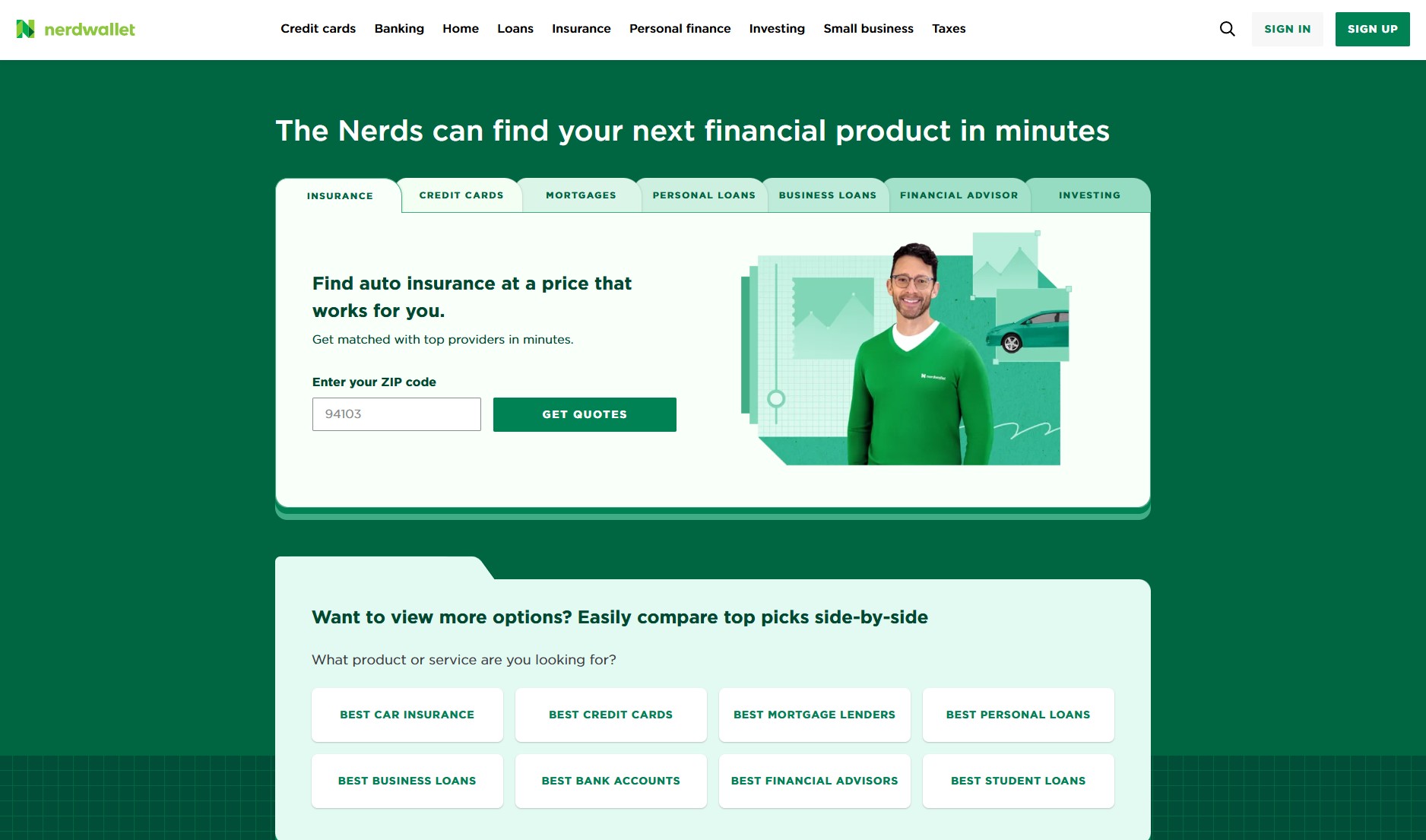
The Promise: The comprehensive financial encyclopedia.
NerdWallet is the 800-pound gorilla of the personal finance world. If a financial product exists, they’ve probably written a review about it.
When it comes to banking comparisons, NerdWallet offers a robust set of tools. Their best-of lists are updated monthly and cover categories as specific as “Best Banks for Digital Nomads” and “Best Credit Unions for Military Families.” Their comparison tables also allow you to sort by APY, monthly fees, and minimum opening deposits.
From a professional standpoint, I respect their commitment to the fine print; they usually clearly disclose if a bank has a monthly fee or a weird tiered interest structure. However, the sheer volume of information can be a double-edged sword, and a simple search for a savings account often leads you down a rabbit hole of credit card offers, loan calculators, and educational articles.
Pros:
- Depth of Data: They cover a massive number of institutions, including smaller credit unions.
- Educational Content: Their explainers on how banking works are generally accurate and helpful.
- Filter Options: You can filter results by very specific criteria.
Cons:
- Information Overload: It’s easy to get distracted by their other product pushes (especially credit cards).
- Cluttered Interface: The pages can feel busy, making it harder to spot the key numbers you’re looking for.
My Verdict: NerdWallet is excellent for those who commit to hours of research before making a choice. However, be aware that their pages are very dense, and you have to be willing to scroll past a lot of general advice just to get to the data.
3. Bankrate

The Promise: The original data warehouse for interest rates.
Bankrate has been around since before the internet was a household utility, originally distributing rate information via print. They’re the old guard of the industry, and they have the data to prove it.
Bankrate’s primary strength is its historical data and the sheer volume of banks it tracks. If there’s a small regional bank in Ohio offering a great CD rate, Bankrate probably knows about it. Their tables are dense, grid-like, and packed with numbers.
For an accountant, this is great. I love raw data. But for the average user, Bankrate can feel a bit like looking at a spreadsheet. The site is also heavily monetized with display ads, which can sometimes make it difficult to distinguish between a “Featured Offer” (an ad) and the actual “Best Rate” (organic data).
Pros:
- Historical Context: They often show rate trends, so you can see if rates are rising or falling.
- Calculators: Their compound interest calculators are some of the best on the web.
- Volume: They track thousands of institutions.
Cons:
- Ad-Heavy: The interface is often crowded with banner ads and sponsored placements.
- Dry: It’s a tool for numbers people, lacking the human touch of modern platforms.
My Verdict: Bankrate is the tool I use when I need to dig deep into CD ladders or obscure mortgage products. For basic savings accounts, it is powerful but clunky. You just have to keep your eyes open and make sure you’re clicking on the data row, not the advertisement row.
4. Forbes Advisor

The Promise: Editorial prestige meets financial utility.
Forbes Advisor is a newer entrant to the scene, but they’ve made a big splash, leveraging the Forbes brand to provide a more editorial take on banking comparisons.
Instead of rattling off 50 banks, Forbes Advisor typically gives you a best-of list with just 10 selected options, each one coming with a mini-review that reads like a magazine article. They also assign star ratings based on a clear methodology (fees, customer experience, digital app quality).
The strength here is the narrative. They don’t just tell you “Bank X pays 4.5%.” They tell you “Bank X pays 4.5%, but their mobile app crashes a lot, so it’s better for a secondary savings fund than your primary checking.”
Pros:
- Qualitative Analysis: They judge the experience of banking, not just the rate.
- Trust: The editorial standards are high here; you rarely see junk products recommended.
- Readability: The articles are well-written and easy to skim.
Cons:
- Lag Time: Rates might be a few days or weeks out of date compared to real-time aggregators.
- Limited Scope: They focus on the top-tier players, so you might miss a great offer from a smaller bank.
My Verdict: I like that Forbes Advisor feels less like a database and more like a recommendation engine. However, their lists are sometimes slower to update than the real-time feeds on other sites, and in a volatile rate environment, that matters.
5. Motley Fool Money

The Promise: Investing-focused banking advice.
The Motley Fool is famous for stock picking, and their personal finance wing carries that same DNA. Their banking comparison tools are designed for people who view their bank account as part of a larger investment strategy.
That said, Motley Fool Money doesn’t try to review every bank in America, instead focusing on a tight list of high-performers. Their reviews are also very conversational and opinionated — they’ll flat-out tell you if a bank’s fee structure is “insulting” or if a rewards program is “generous.”
I find their “Standout Features” section particularly useful, as it highlights whether a bank offers unique perks like ATM fee reimbursements or early direct deposits.
Pros:
- Strong Opinions: They don’t hedge their bets; they tell you what they like and dislike.
- Holistic View: They connect banking choices to broader financial health.
- Trustworthy: They have a strong reputation for independence.
Cons:
- Smaller Database: You won’t find every local credit union listed here.
- Less Customization: It’s harder to generate a custom comparison table based on your specific deposit amount.
My Verdict: If you’re already investing and thinking about your net worth holistically, TMF is a good fit. However, their tool is less of a comparison engine and more of a review hub. You can’t always filter and sort data as easily as you can on BestMoney or Bankrate.
6. Investopedia

The Promise: The academic approach to banking.
Investopedia is where you go to learn what a money market account is, and their comparison tools are only one part of their massive educational library.
When you use Investopedia’s banking tools, you’re getting a lesson along with your recommendation since they explain the methodology in excruciating detail.
That said, the actual comparison interface is clean but somewhat basic. It functions well, but it clearly plays second fiddle to their articles.
Pros:
- Education: Unparalleled explanations of financial terms.
- Safety: Very conservative recommendations that prioritize capital preservation.
- Clarity: No jargon without an explanation.
Cons:
- Not a Power Tool: Lacks the advanced filtering and sorting of dedicated comparison sites.
- Slower Navigation: You have to wade through a lot of text to get to the “Apply Now” buttons.
My Verdict: I send my novice folks here. If someone doesn’t understand FDIC insurance or overdraft protection, Investopedia is the safest place for them. They won’t get tricked into a bad product, and they will learn something in the process. For savvy users, however, the heavy educational focus can slow you down.
The CPA’s Guide to Reading These Tools
Regardless of which platform you choose, you need to know how to read the output. That’s why, as a CPA, I tell my clients to look for three specific red flags that comparison tools sometimes bury in the footnotes.
The Teaser Rate Trap
You’ll often see a rate that looks too good to be true: for example, 6% when the market average is 4.5%. The thing is, that rate might only apply to the first $1,000 you deposit. Maybe the remaining $49,000 earns 0.5%. Perhaps the rate is only valid for the first three months.
So look for the term “blended APY,” or check the rate tiers. I prefer flat rates that apply to the entire balance.
The Active Use Requirement
Some banks offer high yields on checking accounts, but only if you use their debit card 15 times a month.
Do not do this. You’ll end up spending money on coffee just to hit your transaction count, wiping out any interest you earned. Only choose accounts that pay you for saving, not for spending.
The “New Money” Clause
Many of the best offers on these sites are for “new money only.” This means you can’t just transfer money from your checking account at Bank A to a savings account at Bank A to get the rate. You have to bring funds in from an outside institution.
This is why I recommend having accounts at two different banks. It allows you to move money back and forth to qualify for these offers.
Making Your Money Work as Hard as You Do
Interest rates are higher than they’ve been in fifteen years. So if you’re leaving your emergency fund or your tax savings in a standard operational account, you’re losing purchasing power to inflation every single day.
You don’t need to become a day trader or a financial expert to fix this… you just need to move your cash to a high-yield environment.
My advice? Don’t overthink it. You don’t need the “perfect” bank. You just need a better bank.
Use a tool like BestMoney.com to get a quick shortlist of the top contenders. In my opinion, it’s the top pick for folks who want a streamlined, noise-free experience, while NerdWallet and Bankrate are excellent for those looking for deep, exhaustive research.
Whatever you do, pick a bank that’s FDIC-insured, has no monthly fees, and offers a rate above 4%. Open the account, transfer the funds, and get back to running your business or living your life.